





Meet the Cigar Galaxy
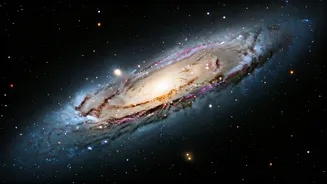
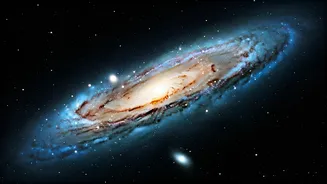
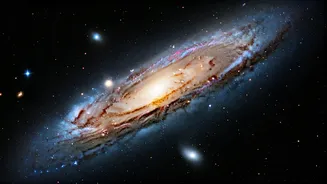
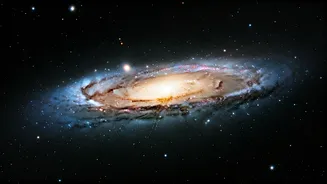
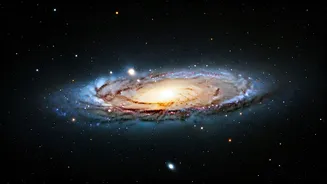
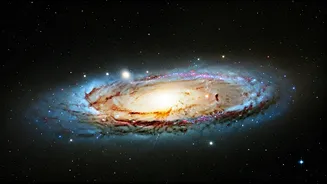
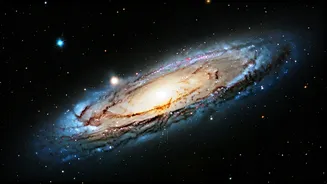
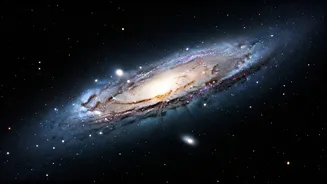
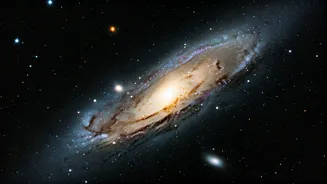
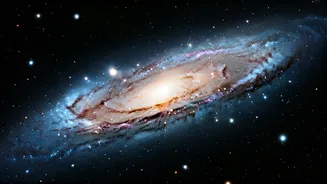
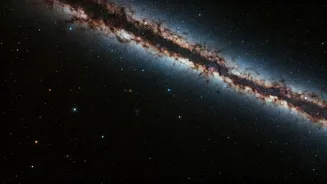
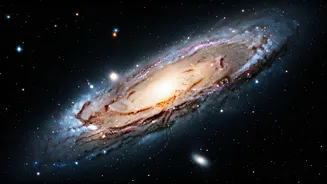
Known formally as Messier 82, or M82, the Cigar Galaxy gets its nickname from its elongated, hazy shape as seen from Earth. Located in the well-known constellation Ursa Major, it's a popular target for both amateur and professional astronomers. From our
perspective, we see the galaxy nearly edge-on, which contributes to its distinct cigar-like appearance. M82 is part of a small cluster of galaxies, and its closest and most influential neighbor is the large spiral galaxy M81, also known as Bode's Galaxy. The two are locked in a gravitational dance, a cosmic relationship that is responsible for M82's most spectacular features and makes it a fascinating object of study.
A Cosmic 'Starburst'
The most defining characteristic of the Cigar Galaxy is that it's a 'starburst' galaxy. This means it's undergoing an incredibly intense and rapid period of star formation. In the galaxy's core, new stars are being born about 10 times faster than in our entire Milky Way galaxy. This frenetic activity isn't a coincidence; it's a direct result of its gravitational interaction with its larger neighbor, M81. Over millions of years, the gravitational pull from M81 has disturbed the gas and dust within M82, causing huge clouds to collapse under their own weight and ignite into millions of new stars. This process makes M82 five times more luminous than our own galaxy.
The Galactic 'Superwind'
This massive wave of star birth creates a truly extreme environment. Many of the newly formed stars are massive, hot, and short-lived. They burn through their fuel quickly and end their lives in cataclysmic supernova explosions, with one occurring roughly every decade in M82. The combined energy from thousands of these stellar winds and supernova blasts generates what astronomers call a 'superwind'. This is a powerful outflow of hot gas and particles blasting out from the galaxy's center, perpendicular to its main disk. Visible in stunning detail in images from the Hubble and James Webb Space Telescopes, these fiery red filaments of hydrogen gas extend for more than 10,000 light-years into space. This superwind is not just visually spectacular; it's also how the galaxy enriches the surrounding intergalactic space with heavy elements forged inside its stars.
A Laboratory for Astronomers
For scientists, M82 is more than just a celestial fireworks show; it's a natural laboratory for understanding some of the most fundamental processes in the universe. By studying it, astronomers can get a close-up view of how galaxy interactions can trigger massive bursts of star formation. It provides insights into how massive stars live and die, and how their deaths seed the cosmos with the building blocks for future stars, planets, and even life. Furthermore, observing the superwind helps explain how galaxies regulate their own growth. The starburst phase is self-limiting; eventually, the violent outflow of gas will blow away the raw material needed for new stars, and the burst of activity will subside in a few tens of millions of years. M82 gives us a snapshot of a crucial, temporary phase that many galaxies may go through.
How to Find M82
The good news for aspiring stargazers is that the Cigar Galaxy is one of the more accessible deep-sky objects. It is bright enough to be spotted with a good pair of binoculars or a small telescope, especially from a location with dark skies. The best time to view it is during the spring in the Northern Hemisphere. To find it, locate the Big Dipper in the constellation Ursa Major. An imaginary line drawn through two of the Dipper's bowl stars, Phecda and Dubhe, and extended outwards will point you to the vicinity of both M82 and its neighbor M81. Seeing the wispy, elongated smudge of M82 and the nearby spiral of M81 in the same field of view is a rewarding experience, offering a direct look at this dynamic galactic pair.