



The Asteroid That Woke Up
In the vast expanse between Mars and Jupiter lies the main asteroid belt, a junkyard of rocky bodies left over from the formation of the solar system. For decades, we saw these as mostly inert, silent worlds. Comets, by contrast, are the dramatic visitors
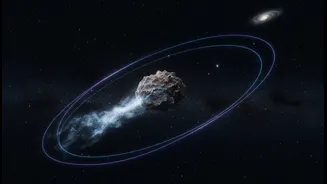
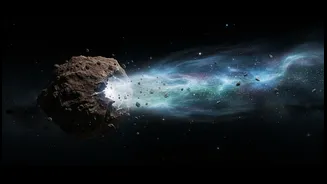
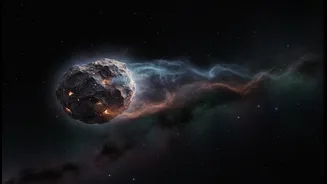
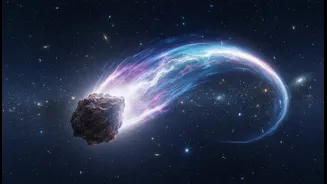
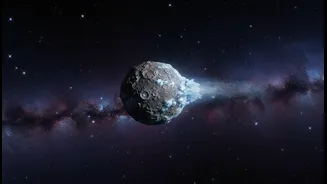
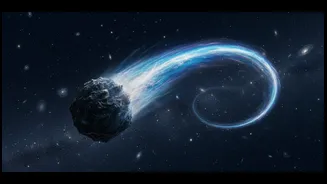
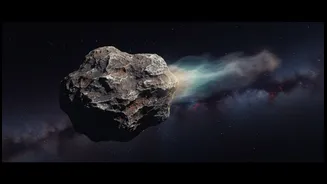
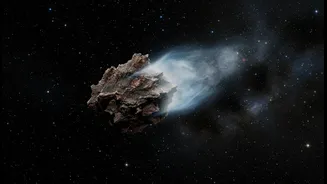
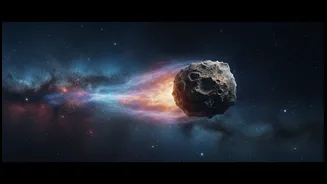
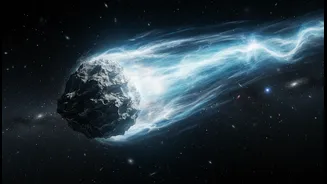
from the solar system's frozen outer edges. When they near the sun, their ice turns to gas, creating spectacular tails. A special class of objects called 'active asteroids' or 'main-belt comets' defies this simple division. These objects have the orbit of an asteroid but display comet-like activity, such as a glowing coma or a tail of dust and gas. Recent observations have once again focused attention on one such object, (248370) 2005 QN173, which has shown recurrent activity. It has an asteroid's orbit but has been seen sprouting a tail, confirming that it isn't just a dead rock. This isn't a one-time fluke; this object has been seen acting like a comet during previous orbits, suggesting an underlying, repeatable process.
Blurring the Lines Between Comet and Asteroid
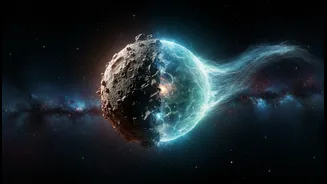
The existence of active asteroids fundamentally challenges our understanding of the solar system's composition. It suggests that water ice isn't just confined to the frigid outer reaches but can survive buried within asteroids in the relatively warmer inner solar system. The activity is believed to happen when a small impact or thermal stress from the Sun exposes a pocket of this ancient ice, which then sublimates—turns directly from solid to gas—and kicks up dust, creating a temporary tail. This discovery implies that there isn't a hard boundary between comets and asteroids but rather a continuum. This has huge implications for one of science's biggest questions: Where did Earth's water come from? For a long time, comets were the prime suspects, but chemical fingerprinting showed their water wasn't a perfect match for our oceans. The water ice found in these main-belt comets, however, could be a much closer match, making them a leading candidate for the source of Earth's life-giving water.
What This Means for Astronomy Readers
For the avid sky-watcher and amateur astronomer, this is an exciting development. It adds a new and dynamic class of objects to observe. While faint, the activity on these asteroids can be captured with advanced amateur equipment, offering a challenging but rewarding project. More importantly, it highlights the crucial role of citizen science. Projects like 'Active Asteroids' enlist volunteers to scan millions of telescope images to find these faint tails, something that automated algorithms can sometimes miss. Discoveries are being made by people just like you, contributing directly to our understanding of the solar system. The recent activity on bodies like 2005 QN173 wasn't found by a major space mission initially, but by ground-based surveys that constantly monitor the sky. This reinforces the idea that with persistence and a keen eye, anyone can contribute to the next big astronomical discovery from their own community or even their backyard.
A New Chapter for Planetary Science Students
If you're a student of planetary science, you're studying a field that is being rewritten in real time. These active asteroids are a perfect case study in how science evolves. The neat definitions in introductory textbooks are proving to be too simple. These objects are natural laboratories for studying a host of processes: sublimation physics, the stability of subsurface ice over billions of years, and the mechanics of dust ejection. Why does one asteroid turn on while its neighbour remains dormant? What triggers the activity, and how long does it last? These are cutting-edge research questions that could form the basis of future projects and dissertations. Furthermore, understanding the composition and behaviour of these bodies is critical for future space exploration and resource utilization. The same ice that creates a beautiful tail could one day be harvested for water, air, and rocket fuel, making these once-overlooked rocks vital assets for humanity's future in space.