
A New Ripple on the Sun's Surface
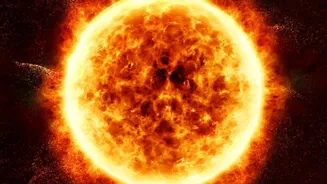
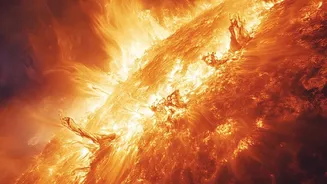
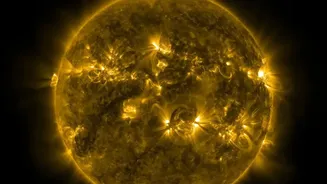
Scientists have captured the most detailed images of the Sun's surface ever, revealing tiny, previously unseen whirlpools of plasma. These vortices, some as small as 20 kilometers wide, are signs of a well-known phenomenon in fluid dynamics called the Kelvin-Helmholtz
instability (KHI). This occurs when two fluids, or in this case plasmas, flow past each other at different speeds, creating a shear that curls into waves and vortices, much like wind blowing over water. While KHI is seen in clouds and even on other planets like Jupiter, observing it at such a fine scale on the Sun's surface is a groundbreaking achievement. These are not slow, giant waves, but fast, small-scale ripples that hint at powerful underlying processes.
Seeing the Unseeable
This discovery was made possible by the Daniel K. Inouye Solar Telescope in Hawaii, the world's largest and most powerful solar observatory. Its massive 4-meter mirror allows astronomers to see the Sun with a resolution that was previously impossible, resolving details on its surface that were once invisible. Researchers from institutions including the National Solar Observatory (NSO) and the Max Planck Institute for Solar System Research combined the telescope's high-resolution images with sophisticated computer simulations to confirm what they were seeing. These observations focused on magnetically active regions near sunspots, revealing a dynamic and chaotic landscape that was even more complex than expected.
Solving the Coronal Heating Puzzle
One of the longest-standing mysteries in solar physics is why the Sun's outer atmosphere, the corona, is millions of degrees hotter than its surface, which is a mere 6,000 degrees Celsius. It defies simple logic, like a fire being cooler than the air around it. Scientists have long theorized that some mechanism must be transporting vast amounts of energy from the surface up into the corona. These newly discovered plasma waves are a prime suspect. The Kelvin-Helmholtz instabilities are thought to generate turbulence that transfers energy from the churning surface into the magnetic field lines that extend into the atmosphere. This process could effectively act as a motor, pumping heat into the corona and explaining its extreme temperatures.
Clues Hidden in the Swirls
The tiny vortices do more than just suggest a heating mechanism; they show how it might work. As the plasma swirls, it twists and braids the Sun's magnetic field lines, similar to winding up a rubber band. This twisting motion stores a tremendous amount of magnetic energy. When these tangled magnetic field lines suddenly snap and reconfigure, that stored energy is explosively released. This release can heat the surrounding plasma and may be the source of so-called nanoflares — a multitude of small, continuous explosions that, when combined, could account for the corona's high temperature. Observing this process at its source is a critical step in confirming these long-held theories.
Implications for Space Weather on Earth
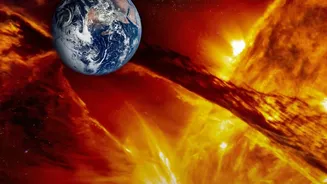
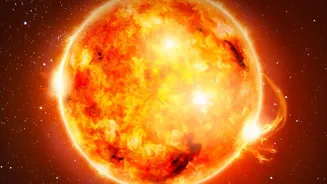
Understanding these fundamental processes on the Sun has direct implications for us on Earth. The same magnetic energy that heats the corona is also what powers massive solar flares and coronal mass ejections (CMEs). When these eruptions are aimed at our planet, they can disrupt satellites, damage power grids, and interfere with GPS and communication systems. By observing the very genesis of this energy buildup in these tiny vortices, scientists can improve their models of solar activity. This could lead to better forecasting of space weather, giving us more time to prepare for and mitigate the effects of potentially damaging solar storms. In essence, seeing these tiny swirls on the Sun helps protect our technology-dependent lives here on Earth.