





Mathura’s Famous Peda
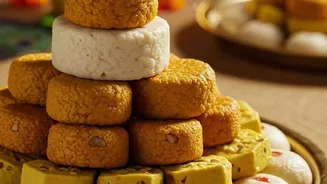
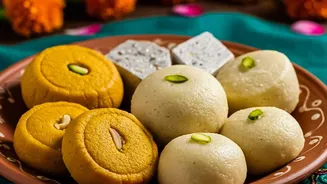
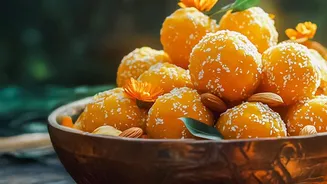
No culinary tour of Janmashtami can begin anywhere but Mathura, the birthplace of Lord Krishna. The city's offering, the Mathura Peda, is legendary. This iconic sweet is made from khoya (milk solids) that is slow-roasted in ghee until it achieves a beautiful
brownish hue and a caramelised, nutty flavour. It’s then mixed with sugar and shaped into small, flattened discs. The peda is not just a sweet; it is an offering, a prasad that embodies the very essence of Braj's dairy-rich culture and devotion. Its soft, grainy texture and rich, milky taste make it a must-have during the festivities.
Maharashtra’s Symbolic Gopalkala
In Maharashtra, Janmashtami is synonymous with the lively Dahi Handi celebrations, and the prasad offered is Gopalkala. This unique savoury dish is a simple yet flavourful mix, said to be a favourite of a young Krishna. It combines flattened rice (poha), yoghurt, chopped cucumber, fresh coconut, and a tempering of ghee, cumin seeds, and green chillies. Some variations also include puffed rice, pomegranate seeds, and soaked chana dal. Gopalkala represents the meal Krishna would share with his friends, the cowherds, making it a dish that symbolises friendship and community. It is a no-cook recipe that is both refreshing and nutritious.
North India’s Essential Panjiri
Across North India, especially in Uttar Pradesh, Punjab, and Delhi, Panjiri is an essential Janmashtami bhog. While the standard version uses whole wheat flour roasted in ghee with sugar and nuts, a special grain-free version is prepared for Janmashtami. This is the Dhaniya Panjiri, made with roasted coriander powder instead of flour. This clever substitution makes it suitable for devotees who are fasting from grains. The roasted coriander powder is mixed with ghee, powdered sugar, chopped nuts like almonds and cashews, and makhana (fox nuts). It's a warm, aromatic, and crumbly preparation that is both a prasad and a nutritious way to break the fast at midnight.
Bengal’s Monsoon Delicacy: Taler Bora
In West Bengal, Janmashtami coincides with the season of the sugar palm fruit (Tal). This gives rise to a beloved seasonal delicacy called Taler Bora, or palm fritters. The pulp of the ripe sugar palm is extracted and mixed with rice flour, semolina, coconut, and sugar or jaggery to form a thick batter. Small dollops of this batter are then deep-fried until they are golden brown and crisp on the outside, while remaining soft and spongy on the inside. These sweet, fragrant fritters are a staple prasad in Bengali households during the festival.
South India’s Crunchy Seedai and Murukku
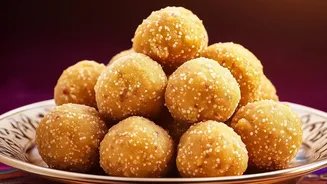
In South India, where the festival is known as Krishna Jayanthi or Gokulashtami, the celebrations are marked by an array of crunchy, savoury snacks. Chief among these are Seedai and Murukku. Seedai are small, crispy balls made from rice flour and urad dal flour. They come in two varieties: Uppu (salt) Seedai, which is savoury, and Vella (jaggery) Seedai, which is sweet. Murukku is another spiral-shaped, crunchy snack made from a similar dough of rice and urad dal flour. Preparing these snacks is a cherished tradition, with families gathering to make large batches to offer as neivedyam (offering) and share with loved ones.