



The Blaze Star's Grand Return
The celestial headliner is a star system called T Coronae Borealis (T CrB), located about 3,000 light-years away. Normally, it’s far too dim to see without a powerful telescope. But roughly every 80 years, it erupts in a spectacular fashion, brightening
over 1,500 times to become as luminous as Polaris, the North Star. This dramatic transformation earns it the nickname 'the Blaze Star'. The last time it put on this show was in 1946. Before that, it was 1866. Now, astronomers at NASA and around the world are certain its next performance is imminent, expected anytime between now and September 2024. For most of us, this is a true once-in-a-lifetime opportunity to witness a nova with our own eyes.
What Is a Recurrent Nova?
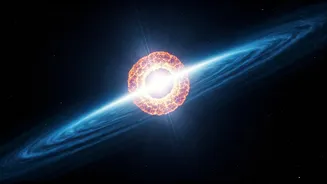
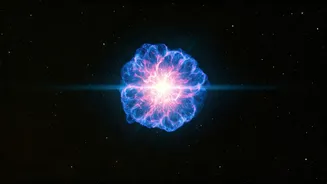
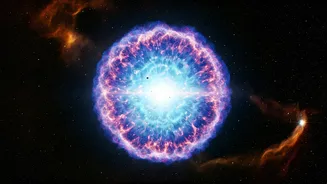
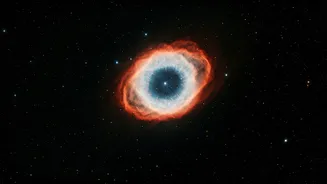
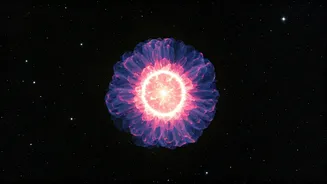
Unlike a supernova, which is a star’s destructive final act, a nova is a surface-level explosion that leaves the star intact. T Coronae Borealis is a binary system, a cosmic pair locked in a gravitational dance. It consists of a white dwarf—the tiny, dense remnant of a sun-like star—and an aging red giant. The red giant is constantly shedding its outer layers, and the powerful gravity of the nearby white dwarf pulls this hydrogen-rich material onto its own surface. Over decades, this stolen matter accumulates, increasing the pressure and temperature on the white dwarf's surface. Eventually, it reaches a critical point, triggering a runaway thermonuclear fusion reaction. The result is a cataclysmic explosion that blasts the accumulated material into space, releasing a tremendous amount of light.
An 80-Year Cosmic Clock
The 'recurrent' part is what makes T CrB so special. Because the white dwarf survives the explosion, the whole process starts over again. It begins siphoning material from its red giant companion, setting the clock for the next eruption. This predictable 80-year cycle makes T CrB one of only a handful of known recurrent novae in our galaxy. Its reliability allows astronomers to study it with a level of anticipation and preparedness that is rare in the often-unpredictable world of cosmic events. The 1946 eruption was extensively studied, but our technological capabilities have grown exponentially since then. This upcoming event will be observed by everything from backyard telescopes to the James Webb Space Telescope, providing an unprecedented wealth of data.
How to See This Celestial Spectacle
You won't need a special invitation or expensive equipment for this show. When T CrB erupts, it will appear as a new star in the constellation Corona Borealis, or the 'Northern Crown'—a small, C-shaped arc of stars. For viewers in India and the rest of the Northern Hemisphere, this constellation is best viewed during the summer months. To find it, look between the bright stars Vega (in the constellation Lyra) and Arcturus (in Boötes). The nova will appear as a temporary bright point within that semi-circle. Once it erupts, it will be visible to the naked eye for several days and with a good pair of binoculars for about a week before it fades back into obscurity. The key is to be ready and to know where to look. Many astronomy apps and websites will provide alerts when the nova is confirmed.
Why This Event Matters
For scientists, this is more than just a cosmic firework display. Observing T CrB’s eruption will provide invaluable insights into how mass is transferred between stars and the physics behind nova explosions. These events are a key process in the universe's chemical evolution, as they eject newly forged elements into interstellar space. For the rest of us, it’s a powerful reminder of the dynamic and ever-changing nature of the cosmos. It’s a direct connection to the sky-watchers of 1946 and 1866 who marvelled at the same 'new star'. In a world of digital distractions, this event offers a chance to look up and witness a profound, fleeting moment of cosmic grandeur.