








What Are These Drills, Exactly?
Walk into any gym, and you might notice a subtle shift. Alongside the clatter of heavy weights, people are meticulously performing slow, controlled movements with simple resistance bands. This is the essence of slow unilateral band drills. The name breaks
it down: 'Unilateral' means working one side of the body at a time (like a single-arm row or single-leg deadlift). 'Band drills' utilize the unique properties of resistance bands. And 'slow' refers to the tempo, emphasizing control and time under tension rather than speed or explosive power. It’s less about brute force and more about building a smarter, more balanced body from the ground up. This approach targets the small, often-neglected stabilizer muscles that are crucial for joint health and proper posture.
The Power of One-Sided Training
For decades, gym culture has glorified bilateral movements like the barbell squat, bench press, and deadlift. While these are fantastic for building overall strength, they have a hidden flaw: they allow your dominant side to compensate for your weaker side. You might not even notice it, but your right leg could be doing 60% of the work in a squat, deepening a muscular imbalance. Unilateral training eliminates this possibility. By forcing each limb to work independently, you immediately expose these asymmetries. Your brain and nervous system have to work harder to maintain balance and stability, firing up muscles that might otherwise lie dormant. This process not only strengthens the weaker side but also improves coordination and proprioception—your body's awareness of its position in space.
Why Resistance Bands Are Key
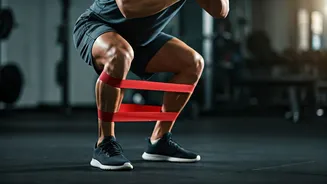
You could perform unilateral movements with dumbbells or kettlebells, so why the specific focus on bands? Resistance bands offer a unique advantage called 'accommodating resistance.' Unlike a free weight, which has a constant gravitational pull, a band’s resistance increases as you stretch it. This means the muscle is challenged through its entire range of motion, especially at the end point where it is typically strongest and most contracted. This variable tension is perfect for waking up stabilizer muscles without overloading the joints with heavy weight. Bands are also portable, affordable, and incredibly versatile, allowing for movements in multiple planes of motion (like rotational or anti-rotational drills) that are difficult to replicate with traditional weights. They provide a gentle but persistent challenge that is ideal for rehabilitation and pre-habilitation.
Slowing Down to Build Up
The final piece of the puzzle is tempo. Rushing through reps using momentum is a common mistake that undermines results and increases injury risk. By intentionally slowing down each phase of the movement—the concentric (lifting), isometric (hold), and eccentric (lowering)—you maximise 'time under tension.' This forces the muscle fibres to work harder for longer, stimulating growth and, more importantly for alignment, enhancing the mind-muscle connection. When you move slowly, you can truly feel which muscles are firing. This deliberate control teaches your body to activate the correct muscles in the correct sequence, re-patterning faulty movements that may have developed over years of sitting at a desk or favouring one side. It turns a simple exercise into a powerful corrective drill.
Three Drills to Get You Started
Ready to try it? Here are three foundational drills. 1. **Banded Single-Leg RDL (Romanian Deadlift):** Loop a light band under one foot and hold the other end in the opposite hand. Keeping your back straight, hinge at the hips, letting your non-working leg float back. Move slowly, feeling the stretch in your hamstring and the engagement in your glute. Focus on keeping your hips level. This is brilliant for hip stability and hamstring strength. 2. **Single-Arm Banded Row:** Anchor a band to a sturdy post at chest height. Grab the band with one hand and step back until there is tension. With your core braced, pull the band towards your chest, squeezing your shoulder blade. The key is to resist the urge to rotate your torso. This builds back strength and anti-rotation core stability. 3. **Pallof Press:** Stand sideways to the band's anchor point, holding it with both hands at your chest. Step away to create tension. Slowly press your hands straight out in front of you, fighting the band's pull to twist you. This is a top-tier exercise for core stability, which is the bedrock of good alignment.