
Finding the Frozen Wells
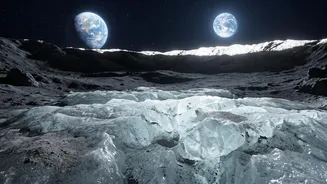
Before you can mine for water, you have to find it. The Moon's South Pole is the target, specifically its permanently shadowed regions—craters and depressions so deep they haven't seen sunlight in billions of years. These areas are incredibly cold, allowing
water ice to remain frozen and stable just beneath the surface. To pinpoint the most promising deposits, NASA is relying on missions like the Volatiles Investigating Polar Exploration Rover, or VIPER. This golf-cart-sized robot is designed to be a lunar prospector. Equipped with a neutron spectrometer, VIPER can detect hydrogen—a tell-tale sign of water—up to a meter below the surface without even touching it. By roving across different soil environments, it will create the first-ever resource maps, guiding future missions to the most water-rich locations.
Drilling into the Darkness
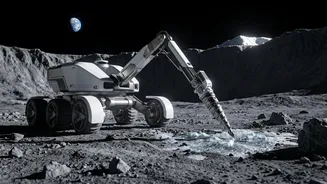
Once a promising site is identified, the next step is to drill into the lunar soil, known as regolith. This isn't easy. At the cryogenic temperatures of the South Pole, the ice-laced regolith can be as hard as granite. NASA has developed specialized drills for the job, like TRIDENT (The Regolith and Ice Drill for Exploring New Terrain). This one-meter-long drill will be part of the PRIME-1 experiment and will also fly on the VIPER rover. TRIDENT is an auger drill that also has a percussive, or hammering, function, allowing it to break through extremely hard materials. It will excavate soil in small increments, bringing the cuttings up to the surface for analysis. This careful, step-by-step process allows scientists to study the regolith at different depths.
The Sublimation Solution
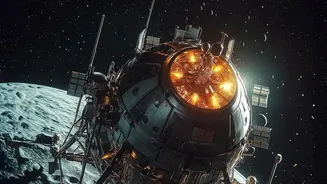
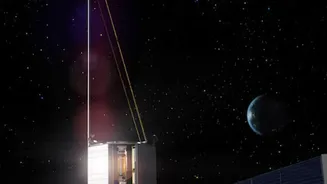
With the icy soil excavated, the extraction process begins. The most developed method involves heating the regolith in a contained environment. Because the Moon is essentially a vacuum, the ice doesn't melt into a liquid first. Instead, it undergoes sublimation, turning directly from a solid into water vapor. Several technologies are being tested for this. One concept involves a mobile robotic plant that would scoop up regolith and heat it in a reactor. Another innovative idea from Georgia Tech proposes using large mirrors, or heliostats, placed on the rim of a crater to beam concentrated sunlight down onto a buried receiver, which then heats the soil. Other methods being explored include microwave heating, which could heat the soil more uniformly and efficiently. The goal is to release the trapped water as a gas that can be collected.
From Vapor to Vital Resource
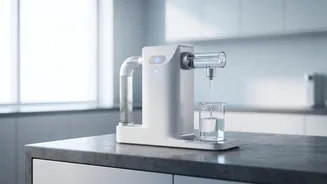
Capturing the water vapor is the critical next step. The gas is funneled into a 'cold trap'—a frigid part of the system that causes the water vapor to freeze again, this time as pure ice, leaving the dust and other impurities behind. This purified ice can then be melted and stored as liquid water. Onboard instruments, like the MSolo (Mass Spectrometer Observing Lunar Operations), analyze the vapor to ensure its purity and detect other useful volatile compounds that were also released during heating, such as carbon dioxide or methane. The result is clean water, ready for use by astronauts. This entire process is a key part of what NASA calls In-Situ Resource Utilization, or ISRU—the practice of living off the land.
More Than Just a Drink
The water extracted from the Moon is valuable for more than just quenching thirst. Through a process called electrolysis, an electric current is passed through the water (H₂O), splitting it into its component parts: hydrogen and oxygen. The oxygen can be used for life support, providing breathable air for astronauts in their habitats and suits. The hydrogen, along with the oxygen, can be used as a powerful, clean-burning rocket propellant. Producing propellant on the Moon would be a game-changer, allowing lunar bases to become refueling stations for spacecraft. This would drastically reduce the cost and complexity of missions deeper into the solar system, including the long-term goal of sending humans to Mars.