





The Challenge of Believing Your Eyes
We are surrounded by images. They tell stories, report news, and shape our understanding of the world. But with the rapid advancement of artificial intelligence, many of the images we see online are not what they appear to be. AI can now generate photorealistic
scenes, from political events that never happened to celebrity encounters that are pure fantasy. Relying on instinct or looking for simple giveaways like six-fingered hands is no longer enough. To navigate this new landscape, we need a more robust method for verification. No single tool is perfect, but by layering several techniques, you can become a much more discerning consumer of visual media.
Step 1: Start with an AI Detector
Your first port of call when questioning an image can be an AI image detector. These tools are trained on vast datasets of both human- and AI-created images to spot the subtle patterns, textures, and artifacts left behind by generative models. Using one is simple: you upload the suspicious image, and the tool provides a probability score of it being AI-generated.
However, it's crucial to understand their limitations. These detectors are not infallible; they can produce both false positives (flagging a real photo as AI) and false negatives (missing an AI-generated one). Their accuracy can be compromised by a number of factors, including if the image has been compressed, screenshotted, or heavily edited after generation. As of mid-2026, even major tech companies acknowledge that their detectors struggle with simple modifications like cropping. Think of a detector's result not as a final verdict, but as your first piece of evidence.
Step 2: Perform a Reverse Image Search
Regardless of what the AI detector says, your next step should be a reverse image search. Tools like Google Images, TinEye, and others allow you to use an image as your search query. Instead of typing words, you upload the picture to find where else it has appeared online, when it first appeared, and in what context.
This is incredibly powerful for several reasons. If the image is being presented as a recent event, but a reverse image search shows it has been circulating for years in a completely different context, you've likely spotted misinformation. If you find the original, high-resolution version on a photographer’s official website or a reputable news agency, you can gain confidence in its authenticity. Conversely, if an AI-generated image is new, a reverse search may come up empty, which itself is a clue. This step is crucial for uncovering the history and usage of an image, which AI detectors alone cannot provide.
Step 3: Look for Provenance with Content Credentials
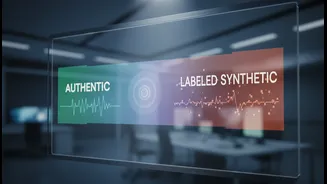
The most definitive check involves looking for digital provenance, often through a system called Content Credentials. Think of this as a secure, tamper-evident digital label that travels with the image file. This technology, powered by an open standard called C2PA (Coalition for Content Provenance and Authenticity), is being adopted by major camera manufacturers, software companies like Adobe, and news organizations.
A Content Credential can tell you who created the image, what device it was captured on, and a log of any edits made, including whether generative AI tools were used. You can check for these credentials by uploading the image to a verification site like contentcredentials.org. The presence of a detailed, unbroken credential from a trusted source is a strong signal of authenticity. The absence of one isn't automatically a red flag, as the technology is still being rolled out, but its presence provides a layer of trust that other methods can't match. It certifies the history of the content, not its truthfulness, giving you the facts to make an informed decision.
Putting It All Together: A Detective's Mindset
The true power of this process comes from combining the results. Each step provides a different piece of the puzzle. An AI detector might flag an image as 90% likely to be synthetic. A reverse image search might find no other copies of it online, suggesting it’s a new creation. The lack of any Content Credentials would further support the theory that it didn't come from a verified photographic source. In this scenario, you have three data points all pointing to the image being AI-generated.
Conversely, if an AI detector gives a 50/50 result, but a reverse image search traces it back to a major news agency's wire photo from five years ago, and you can see the original context, you can safely ignore the detector's ambiguity. The historical context provided by the reverse search is the more reliable signal. The key is not to rely on any single “magic” tool, but to use these methods together to build a compelling case for whether an image is authentic or not.