





A Laboratory Without Gravity
On Earth, gravity is a constant, invisible force that governs everything. It causes hot air to rise, particles in a liquid to settle, and structures to require support. But in the microgravity of low-Earth orbit, these fundamental rules no longer apply.
This near-weightless environment eliminates phenomena like convection and sedimentation. Without gravity's pull, scientists can observe and manipulate materials in ways that are impossible on the ground. This makes space, and specifically the International Space Station (ISS), an unparalleled laboratory. Researchers can study the pure interactions between molecules, grow more perfect crystals, and layer materials with unprecedented precision. This opens the door to creating entirely new products and gaining deeper insights into processes we thought we understood.
Medicine's Next Frontier
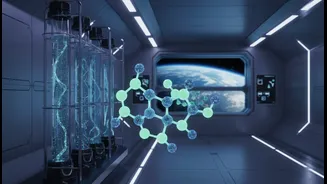
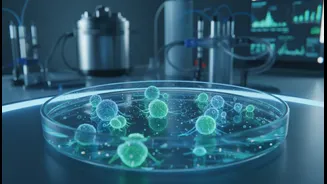
Some of the most promising microgravity research is happening in medicine. On Earth, growing complex, three-dimensional human tissues in a lab is incredibly difficult because gravity causes delicate structures to collapse. In space, however, 3D bioprinting can create more complex and viable tissues and organoids without the need for supportive structures. Scientists are successfully printing meniscus tissue and cardiac tissue aboard the ISS, with the long-term goal of one day creating custom replacement organs that could be sent back to Earth. This could dramatically shorten organ transplant waiting lists. Furthermore, microgravity is ideal for protein crystallization. Understanding a protein's 3D structure is key to designing effective drugs, and space-grown crystals are often larger and more perfect, providing clearer insights for developing new treatments for diseases like cancer and HIV.
Manufacturing High-Performance Materials
The future of high-tech manufacturing may also lie in orbit. Take semiconductors, the tiny chips that power all modern electronics. On Earth, gravity can create tiny defects in the crystalline structures of semiconductor materials, limiting their performance. Research shows that crystals grown in space can be larger, grow faster, and have up to 1,000 times fewer defects. This could lead to a new generation of more powerful and efficient computer chips. Another area of focus is fiber optics. A special type of fluoride glass fiber called ZBLAN has the theoretical potential to be 10 to 100 times more efficient than the silica fibers used today. However, producing it on Earth is plagued by gravity-induced imperfections. In space, companies are demonstrating the ability to manufacture long, flawless strands of ZBLAN, which could revolutionize global telecommunications.
The Growing Business of Space
For decades, this research was the domain of national space agencies. Today, a bustling commercial marketplace is emerging in low-Earth orbit. The cost to launch materials into space has plummeted, from over $50,000 per kilogram on the Space Shuttle to as low as $951 on commercial rockets. This economic shift has made in-space research and manufacturing a viable business proposition. Private companies are now developing their own orbital platforms and manufacturing facilities. With the ISS scheduled to retire around 2030, these commercial space stations will become essential for continuing this critical research. This public-private partnership model is designed to ensure there is no gap in humanity's access to the unique benefits of the microgravity environment, fostering a new economy based on orbital innovation.