




Your Front-Row Seat to the Cosmos
The glow of city lights can feel like a curtain drawn across the universe, obscuring the delicate tapestry of distant stars. But this light pollution is selective. It primarily washes out fainter objects, leaving the brightest stars and our solar system’s
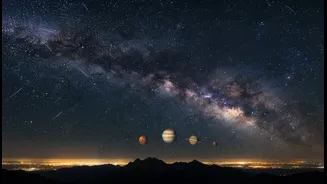
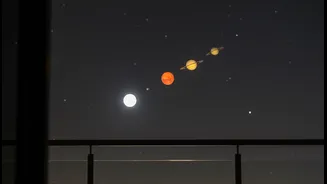
planets clearly visible. Planets like Venus, Jupiter, Mars, and Saturn don't twinkle like stars; they shine with a steady, brilliant light that can cut through the urban haze. This makes them perfect targets for city-based astronomers. Cosmic alignments, or 'planet parades', occur when several planets appear close together in a small section of the sky from our perspective on Earth. These events are often bright enough to be seen with the naked eye even from a bustling metropolis, offering a spectacular and accessible cosmic show.
Your Pocket Planetarium: Top Free Apps
The single most powerful tool for an urban skywatcher is a stargazing app. These apps use your phone’s GPS and compass to create a real-time map of the sky above you. Simply point your phone upwards, and the app will identify stars, constellations, and, most importantly, planets. Many even use augmented reality (AR) to overlay this information onto your camera's view of the sky. While there are many options, a few free apps are consistently praised for their user-friendly design and powerful features: Star Walk 2: Ideal for beginners, this app has a beautiful interface and provides extensive information about celestial objects. Its 'Time Machine' feature lets you see the sky on different dates, helping you plan for future alignments. SkyView Lite: Known for its intuitive AR feature, SkyView Lite makes identifying objects as simple as pointing your phone. It works offline, making it perfect for trips to parks or areas with spotty signal. * Stellarium Mobile Free: This app offers a highly realistic and detailed star map, showing what you see when you look up. It has a massive catalogue of stars, nebulae, and planets, making it a powerful tool for those who want to dive deeper.
A Step-by-Step Guide to Finding Alignments
Once you have your app, tracking an alignment is straightforward. First, stay informed about upcoming celestial events. Astronomy websites and the apps themselves will often list dates for notable alignments. When the night arrives, find the best possible viewing spot. This could be a rooftop, a balcony, or a local park—anywhere with a relatively unobstructed view of the horizon. Give your eyes at least 20-30 minutes to adjust to the darkness. Then, open your stargazing app. Use its search function to locate the planets involved in the alignment. The app will then guide you, often with an on-screen arrow, showing you exactly where to look in the real sky. The planets will appear as a string of bright, steady lights along a path known as the ecliptic.
Tips for the Best Urban Viewing Experience
To maximise your chances of a great sighting, a little planning goes a long way. Check the weather forecast for a clear, haze-free night; atmospheric particles scatter city light and make the sky even brighter. The best time to view planetary alignments is often shortly after sunset or just before sunrise, when the planets are visible but the sky isn't completely dark. If you can, face away from the brightest part of the city. Even moving to a local park or finding a spot shielded by buildings can make a significant difference. While naked-eye viewing is rewarding, a simple pair of binoculars can dramatically enhance the view, potentially revealing the moons of Jupiter or the distinct colours of Mars.
What to Look for in Late 2026
The cosmic calendar is always full of exciting events. For instance, a notable large alignment of six planets—including bright Jupiter and Saturn—is expected to be visible in the morning sky around August 2026. While some of these planets like Uranus and Neptune will require binoculars, the brighter ones will be accessible to naked-eye observers in India. Earlier, in June 2026, a trio of bright planets—Mercury, Venus, and Jupiter—will gather in the evening sky just after sunset, offering an easy and beautiful target for beginners. Using your app, you can set reminders for these events and see exactly where to look from your specific location as the dates approach.