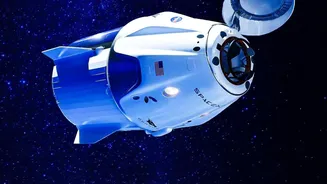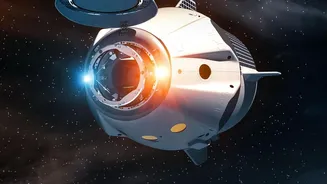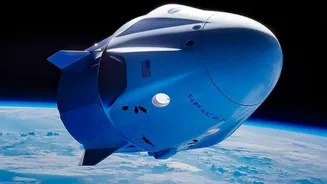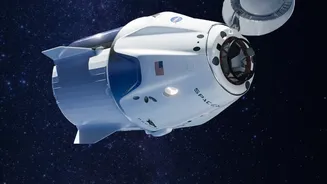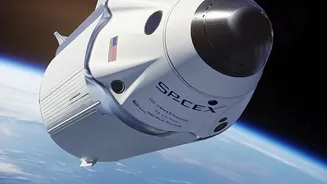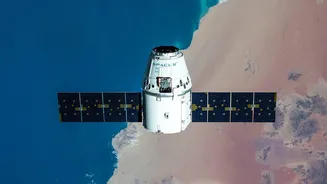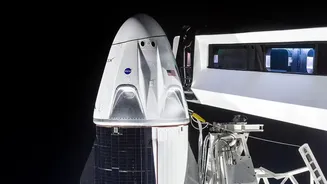




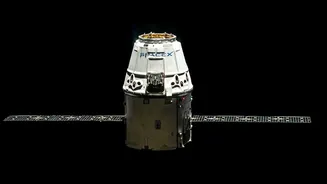

A SpaceX Dragon capsule successfully splashed down in the Pacific Ocean, completing the company's 35th commercial resupply mission for NASA. This recovery marks another milestone for the bustling low-Earth orbit economy and a crucial step for science.
A Successful Splashdown
On Saturday, November 21, a SpaceX Dragon spacecraft parachuted into the Pacific Ocean off the coast of California, bringing its journey to the International Space Station (ISS) and back to a successful close. The uncrewed capsule undocked from the station on November 20, completing a roughly 29-hour solo flight home. Recovery ships were on standby to retrieve the capsule, which contains thousands of pounds of valuable cargo, including critical scientific experiments that can only be analyzed in labs on Earth. This splashdown concluded the CRS-35 mission, the 35th such flight conducted by SpaceX under its Commercial Resupply Services contract with NASA, underscoring the reliability of this public-private partnership.
The Vital Return Cargo
While sending supplies up to the station is vital, the Dragon's ability to return cargo intact is what makes these missions revolutionary. Other cargo vehicles burn up on reentry, but Dragon acts as a round-trip delivery service for science. Onboard CRS-35 was a treasure trove of research materials. This includes a 3D-bioprinted blood vessel structure used to study cardiovascular disease and the aging process in space. Also returning were frozen tumor organoids that may help scientists find new ways to improve cancer treatments. Another experiment involved microbial samples, which will be analyzed to understand how antibiotic-resistant bacteria adapt and evolve in microgravity.
More Than Just Science Samples
Beyond the time-sensitive biological samples, the Dragon capsule also returned important hardware. One significant item was a specialized lighting system that had been tested aboard the ISS for over three years. Researchers hope the system, which mimics natural light patterns on Earth, can help support astronauts' sleep cycles and well-being on long-duration missions. Additionally, the mission brought back a failed wrist joint from the station's robotic arm, Canadarm2. Engineers on the ground will now inspect the joint to diagnose the malfunction and potentially refurbish it for future use. Even an EMU spacesuit was part of the return manifest, destined for analysis back on Earth.
A Two-Way Logistics Highway
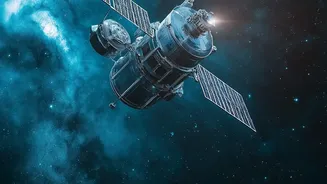
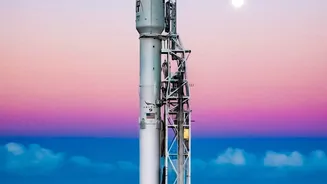
The CRS-35 mission began on October 13, when a Falcon 9 rocket launched the Dragon spacecraft from Cape Canaveral, Florida. It arrived at the ISS two days later, delivering over 6,300 pounds of supplies, station hardware, and new experiments for the orbiting crew. Among the cargo delivered were the final pair of International Space Station Roll-Out Solar Arrays (iROSAs). These new arrays have significantly boosted the station's power generation capabilities, enabling more extensive research and operations as it continues to orbit the Earth. The successful end-to-end mission demonstrates the maturity of the commercial model for sustaining the ISS, which has become a bustling hub for science and technology development.