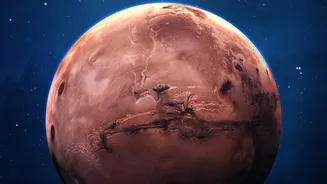


To solve one of the biggest mysteries of the Red Planet, NASA has supplied a crucial piece of technology for an international mission. The goal: to visit the moons of Mars and finally determine where they came from.
A Mission to the Martian Moons
The Japan Aerospace Exploration Agency
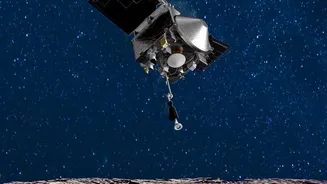
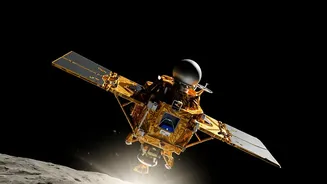
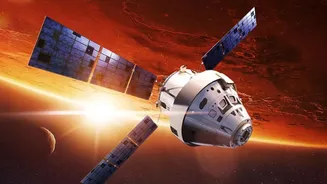
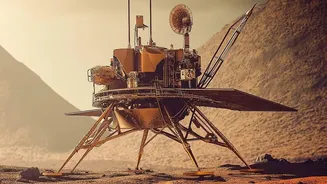
(JAXA) is leading one of the most ambitious space ventures of the decade: the Martian Moons eXploration (MMX) mission. Launched in late 2026, the MMX spacecraft is on a multi-year journey to orbit Mars and conduct close-up studies of its two small, enigmatic moons, Phobos and Deimos. The primary objective is to solve a long-standing debate about their origin. After comprehensive observation, the spacecraft will land on Phobos, collect at least 10 grams of surface material, and return this precious cargo to Earth for analysis in 2031. It marks the first-ever sample return from the Martian system, a major technological feat requiring international cooperation.
NASA's High-Tech Contribution
While JAXA leads the mission, NASA is a key partner, contributing a sophisticated scientific instrument named MEGANE. The name, pronounced 'meh-GAH-nay', is the Japanese word for 'eyeglasses', a fitting title for a device designed to see the elemental composition of Phobos. MEGANE stands for Mars-moon Exploration with GAmma rays and NEutrons. Developed by the Johns Hopkins Applied Physics Laboratory (APL) and Lawrence Livermore National Laboratory, this gamma-ray and neutron spectrometer was delivered to JAXA and integrated into the MMX spacecraft ahead of its launch. It is one of 13 scientific instruments aboard but plays an outsized role in achieving the mission's core science goals.
Reading the Surface from Orbit
So how do 'eyeglasses' read the composition of a moon from orbit? MEGANE doesn't look at the surface in the traditional sense. Instead, it measures invisible radiation. The surfaces of airless bodies like Phobos are constantly bombarded by high-energy cosmic rays. These impacts kick off a shower of secondary particles, including gamma rays and neutrons. The energy of these emitted particles is unique to the elements in the soil that produced them, creating a sort of chemical fingerprint. MEGANE will detect and analyze these gamma-ray and neutron signatures to create a detailed map of elements like iron, silicon, oxygen, and others on the moon's surface, effectively peering into its chemical makeup without ever touching it.
Solving a Solar System Riddle
The data from MEGANE is critical to answering the mission's central question: are Phobos and Deimos captured asteroids, or are they the remnants of a giant impact on Mars billions of years ago? The two theories lead to very different predictions about the moons' composition. If they are captured asteroids, their elemental makeup should resemble that of carbon-rich asteroids found in the outer solar system. If they were formed from Martian debris flung into orbit by a colossal collision, their composition should be much more similar to the crust of Mars itself. By determining the elemental abundances on Phobos, MEGANE will provide the key evidence needed to solve this enduring mystery, offering profound insights into the violent and dynamic history of the early solar system.
The Power of Global Partnership
The MMX mission, with contributions from NASA, the French space agency (CNES), and the German Aerospace Center (DLR), is a prime example of the modern, collaborative approach to big science. Undertaking complex and expensive missions like a sample return from the Martian system is often beyond the capability of a single nation. By pooling resources, technology, and scientific expertise, international partners can achieve goals that would otherwise be impossible. NASA's MEGANE provides a capability that complements the other instruments, while JAXA's spacecraft and sample return systems provide the platform for discovery. This model of shared investment and shared reward is becoming the standard for flagship planetary science missions, pushing the boundaries of human knowledge further into the cosmos.