






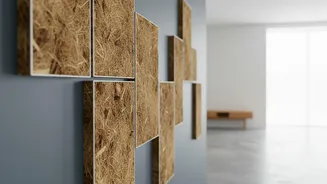

From Farm Fields to Quieter Rooms
Every year, vast quantities of agricultural residues like rice and wheat straw are produced. In many parts of India, this results in stubble burning, a practice that causes severe air pollution. Similarly, coconut husks from the nation's massive coconut industry
often end up as waste. Now, innovators are transforming this 'waste' into wealth by creating bio-composite panels. The process typically involves cleaning, drying, and processing the fibres from straw and husks. These fibres are then mixed with a binder, often a natural or eco-friendly resin, and compressed under heat and pressure to form dense, rigid boards. This approach is a prime example of a circular economy, turning a low-value byproduct into a high-performance, sustainable building material.
The Simple Science of Sound Absorption
So, how does a panel made of straw or coconut coir quiet a room? The secret lies in its structure. Natural fibres like coir and straw have an inherently porous and irregular internal structure. When sound waves from traffic, conversation, or music hit the panel, they penetrate this fibrous maze. As the waves travel through the tiny gaps and passages, their energy is converted into a minuscule amount of heat, effectively dampening the sound and reducing reverberation. This makes them particularly effective at absorbing sounds in the mid-to-high frequency range, which includes human speech. Unlike flat, hard surfaces that reflect sound and create echoes, these bio-panels trap it, leading to better acoustic comfort.
More Than Just Sustainable
The environmental benefits are clear: using renewable resources reduces our carbon footprint and reliance on synthetic materials. But the advantages of these bio-panels extend much further. Many conventional insulation materials contain synthetic fibres or volatile organic compounds (VOCs) that can be harmful to health. Panels made from natural fibres are non-toxic, hypoallergenic, and contribute to better indoor air quality. They are also 'breathable' materials, meaning they can help regulate humidity by absorbing and releasing moisture from the air, which reduces the risk of mould and dampness. Furthermore, depending on their density and the manufacturing process, these panels can offer excellent thermal insulation, keeping rooms cooler in the summer and warmer in the winter, thus saving on energy bills.
An Indian Solution to an Indian Problem
This technology holds immense promise for India. The country is one of the world's largest producers of both agricultural crops and coconuts, generating millions of tonnes of residue annually. Creating a market for this waste provides farmers with an additional stream of income and directly addresses the environmental crisis of stubble burning. With a booming construction sector and a government push for green building and 'Make in India' initiatives, locally produced bio-panels are a perfect fit. Research and development within India are already exploring the fabrication of eco-friendly composite panels from materials like rice husk and coconut coir, highlighting the feasibility for local production.
Challenges on the Path to Adoption
Despite the clear benefits, the widespread adoption of straw and coconut husk panels faces some hurdles. The primary challenge is scaling up production to compete on cost and availability with established synthetic materials like foam or mineral wool. The manufacturing process involves collecting, transporting, and processing bulky agricultural materials, which requires robust logistics. Furthermore, there is a need for greater awareness among architects, builders, and homeowners about the performance and long-term benefits of these natural alternatives. Standardisation and quality certification, like those for fire resistance and acoustic performance, will also be crucial to building trust and ensuring consistent product quality across different manufacturers.