


A Parade of Planets
September kicks off with a brilliant display from our solar system neighbours. Keep an eye on the Moon from September 6 to 14, as it makes a journey past four planets. Our natural satellite will have close encounters with Mars, Jupiter, Mercury, and finally,
a beautiful crescent Moon will meet the dazzling planet Venus on September 14. Mars will appear as a faint predawn object, but you can use the crescent Moon to locate it on September 6 and 7. Jupiter will have its own close call with the Moon on September 8. These events will be visible to the naked eye, offering a fantastic opportunity to track the movements of the planets night after night.
September Epsilon Perseids Meteor Shower
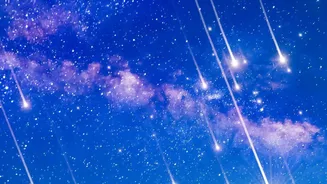
While the famous August Perseids get all the attention, September has its own, more subtle shower: the Epsilon Perseids. This minor meteor shower is active from September 5 to 21, with its peak expected around September 9. While not as prolific as its August counterpart, you might be able to spot around five to eight meteors per hour under ideal, dark-sky conditions. The good news for 2026 is that the shower's peak coincides with a thin crescent moon, meaning moonlight interference will be minimal, making it easier to spot these fleeting streaks of light. For the best views, find a location away from city lights, let your eyes adjust to the dark, and look towards the constellation Perseus in the hours before dawn.
Venus at Its Brightest
The planet Venus, often called the 'Evening Star', will be an unmissable beacon in the twilight sky this month. On September 22, it reaches its peak brightness for the entire year, shining at a dazzling magnitude of -4.8. Look for it low above the southwestern horizon just after sunset. Interestingly, if you were to look at Venus through a telescope at this time, you would see it as a thin, beautiful crescent. It's at its brightest not when its face is fully lit, but when its increasing closeness to Earth creates a larger apparent size, which compensates for the shrinking crescent phase.
The Autumnal Equinox
This isn't a visual event, but it is a significant astronomical moment. On September 23, at approximately 5:35 AM IST, the Sun will shine directly over the Earth’s equator. This marks the Autumnal Equinox in the Northern Hemisphere, the official start of the astronomical autumn season. On this day, the length of day and night are nearly equal across the entire planet. For skywatchers in India, this is welcome news; from this point forward, the nights will grow longer than the days, providing more precious hours for stargazing as we head into the cooler, clearer months.
The Full Harvest Moon
September 26 brings the month's lunar highlight: the Full Harvest Moon. This is the name given to the full moon that occurs closest to the Autumnal Equinox. It will reach its peak illumination during the day for India, but will appear perfectly full to the naked eye on the nights of September 25, 26 and 27. This moon gets its name from the extra evening light it provided to farmers harvesting their crops. For a few nights around its peak, the moon rises at nearly the same time shortly after sunset, a unique feature of the Harvest Moon. On the same night, the distant planet Neptune will be at opposition, its closest point to Earth for the year. However, as an ice giant, it will only be visible as a tiny blue-green dot through a powerful telescope.