





Why August is Prime Time for Planet Watchers
August 2026 is an excellent month for observing Saturn. The planet is steadily brightening as it approaches its opposition on October 4. Opposition is when Earth passes directly between the sun and an outer planet, placing Saturn opposite the sun in our
sky. Around this time, the planet is at its closest and brightest for the year, making it an ideal target. In August, Saturn rises in the mid-evening and remains visible for most of the night, climbing high in the sky after midnight. This gives observers a long window to find it. On the nights of August 30 and 31, the moon will pass close to Saturn, making the planet exceptionally easy to locate for beginners.
What Exactly Are You Seeing?
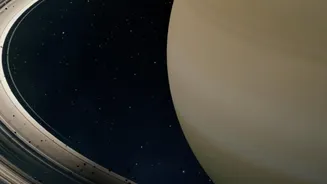
Saturn’s rings are one of the most breathtaking sights in our solar system. They are not solid but are made of billions of individual particles of water ice and rock, ranging in size from tiny dust grains to large boulders. These particles orbit the planet in a vast, flat disk. Though the ring system spans hundreds of thousands of kilometres, it is astonishingly thin—in most places, only about 10 to 100 meters from top to bottom. This incredible scale means that when the rings are tilted edge-on to us, as they will be in 2025, they seem to disappear. This makes the current viewing opportunity, while the rings are still angled towards us, even more special.
How to Spot Saturn and Its Rings
To the naked eye, Saturn appears as a bright, yellowish, and steady point of light, unlike the twinkling of distant stars. In August 2026, it will be visible in the constellation Pisces. While you can spot the planet without any equipment, you will need a telescope to see its famous rings. Fortunately, you don't need a professional observatory. Even a small beginner's telescope with a magnification of 30x to 50x is enough to resolve the rings as a distinct structure separate from the planet itself. With a slightly larger amateur telescope (100mm-125mm), you might even be able to spot the Cassini Division, a prominent dark gap between the main A and B rings. Binoculars will enhance the planet's golden colour but are generally not powerful enough to clearly distinguish the rings.
Tips for Stargazers in India
The biggest challenge for stargazing in India during August is the monsoon. However, breaks in the cloud cover are common, especially in the latter half of the month. For the best views, try to get away from city lights which cause significant light pollution. High-altitude regions like Ladakh and Spiti Valley, or drier areas like the Rann of Kutch, offer the darkest and clearest skies. But even finding a dark spot in a local park or on a rooftop away from direct streetlights can make a huge difference. Allow your eyes about 20-30 minutes to fully adapt to the darkness; this will help you spot fainter objects. Stargazing apps on your smartphone can help you locate Saturn and other celestial objects with ease.
A Fleeting Cosmic Wonder
Observing Saturn's rings is a chance to witness a relatively temporary feature of our solar system. Data from NASA missions has revealed that the rings are actively losing material, which is being pulled into the planet by gravity in a phenomenon dubbed "ring rain." Scientists estimate that because of this process, the rings could be completely gone within the next 100 to 300 million years. While that sounds like a long time, in cosmic terms, it is quite short. It means we are lucky to be alive in an era when Saturn has this magnificent halo.