




A Universe in a Hurry
Our understanding of the universe's first billion years has long been guided by a simple idea: that the first galaxies were small, messy, and took a long time to get organised. But a flood of recent discoveries is challenging that picture. Astronomers
are finding galaxies that appear surprisingly mature and well-structured at a time when the cosmos was just a fraction of its current age. It’s like looking at a photograph of what should be a group of toddlers and finding they are already behaving like teenagers. This is forcing a major rethink of how quickly the first stars ignited and how rapidly the grand cosmic structures we see today began to take shape. The early universe, it seems, was in a tremendous hurry.
Mature Galaxies at Cosmic Dawn
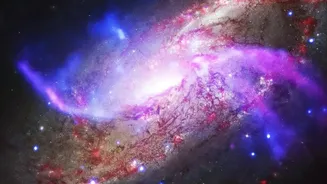
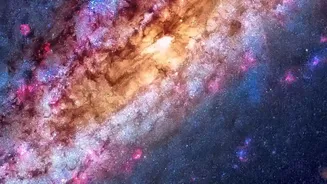
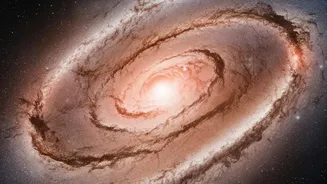
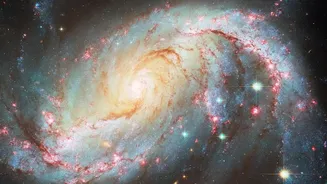
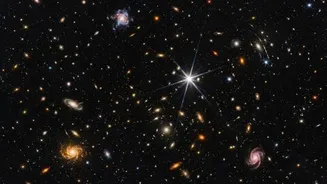
The James Webb Space Telescope (JWST) was built to find the very first, faintest galaxies. What it has found instead are systems that are far more developed than models predicted. One recent study identified a galaxy with a dense, spinning disc of stars at its core, seen when the universe was only about 4.5 billion years old. Such orderly structures, known as nuclear discs, were thought to belong to much older, more settled galaxies. Finding one this early suggests that the processes of galaxy-building were already efficient and sophisticated just a few billion years after the Big Bang. Similarly, astronomers studying a massive early structure dubbed the "Cosmic Vine" found a surprising number of large, "dead" galaxies that had already stopped forming new stars, a sign of rapid aging.
The Black Hole Connection
So why did these early galaxies live so fast and, in some cases, die so young? A leading suspect is the supermassive black hole lurking at the centre of nearly every large galaxy. These cosmic engines don’t just swallow matter; their immense energy output can have a profound effect on their surroundings. Recent observations of a distant galaxy nicknamed the "Red Potato" show how a powerful black hole can heat up and blow away the cold gas needed to form new stars. This process, known as feedback, can effectively shut down or "quench" star formation. New studies suggest this feedback may be a more important factor in a galaxy's evolution than dramatic events like galactic collisions. It appears a black hole's long-term influence is a key regulator of how a galaxy grows and when it stops.
Rewriting the First Chapter
These unexpected discoveries do not overturn the Big Bang theory, but they do add crucial, complex new details to the first chapter of cosmic history. The presence of surprisingly complex molecules and heavy elements, which astronomers call 'metals', in these infant galaxies also poses a puzzle. These elements are forged inside stars and scattered when they die, a process that should take time. Finding them in abundance so early suggests that the first generations of stars may have formed, lived, and died even faster than we imagined. Scientists are now running sophisticated computer simulations to test new theories that could account for this accelerated evolution. The goal is to build a more complete model that matches what our powerful new telescopes are actually seeing.