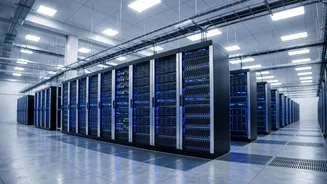







India's digital backbone is in the midst of a supercycle. Spurred by the explosive growth of Artificial Intelligence, the nation's data centre capacity is set for a massive expansion, attracting trillions of rupees in investment.
The AI-Fueled Investment Boom
A recent report from Crisil
Ratings forecasts that India's data centre capacity will skyrocket, potentially increasing five-fold to 7.5 gigawatts (GW) by March 2030. This expansion is expected to attract investments exceeding ₹3 trillion over the next four years. The primary driver behind this gold rush is the voracious computing appetite of generative AI. Unlike traditional applications, AI workloads require immense power and specialised infrastructure, pushing demand for data centre space to unprecedented levels. This demand is compounded by ongoing enterprise digitalisation and rising data consumption across the country.
De-Risking a Trillion-Rupee Bet
Building a data centre is a capital-intensive affair, with multi-year timelines and massive upfront costs for land, construction, and power infrastructure. This is where long-term contracts become the crucial shock absorber for investors. According to Crisil, nearly half of the upcoming capacity is already pre-booked under long-term agreements, significantly reducing the risk of building speculative, empty facilities. These contracts, primarily with 'hyperscalers'—the global tech giants that provide cloud services—offer developers clear revenue visibility from the outset. This financial certainty is essential for securing the enormous loans required for such large-scale projects.
The Anatomy of a Modern Data Centre Deal
The nature of these deals is also evolving. Contract tenures are stretching from the earlier standard of 10-12 years to 15-20 years now. For hyperscale clients, locking in space for longer periods ensures they have the capacity to serve the booming Indian market. For developers, it provides a stable, predictable income stream that justifies the huge initial investment. Existing data centres in India are already running at high utilisation, around 90%, and over 95% of the capacity currently under construction is pre-contracted, underscoring the intense demand. This symbiotic relationship is the engine powering the sector's expansion, with players like STT GDC, CtrlS, NTT, and AdaniConneX all making significant investments.
India's Competitive Edge
Beyond strong demand, India has structural advantages that make it an attractive data centre hub. Crisil notes that development costs in India are approximately 20% lower than in competing Asia-Pacific markets, thanks to more competitive land, construction, and labour costs. Furthermore, lower power tariffs translate into rental rates that are 30–35% cheaper than in peer markets. This cost–effectiveness, combined with the ability to develop large campuses powered by renewable energy, is a major draw for global cloud providers who are increasingly focused on sustainability.
Challenges on the Horizon
Despite the positive outlook, the path to 7.5 GW is not without obstacles. The biggest challenge is power. The report highlights that the immense concentration of new data centres in cities like Visakhapatnam, Mumbai, and Hyderabad could strain local electricity grids. By 2030, data centres in these cities could consume a significant portion of their current peak power demand. This makes timely grid connectivity and infrastructure upgrades critical. Another potential risk is customer concentration. With hyperscalers expected to lease 75–80% of capacity by 2030, developers could face pricing pressure as these powerful clients gain more bargaining power.