



The Partnership Paradigm
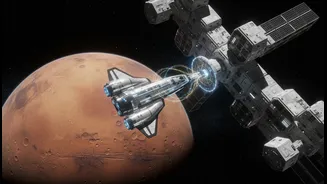
In recent years, NASA has enthusiastically embraced a new model for space exploration, one built on collaboration with commercial companies. This approach, which has proven successful for missions to the International Space Station and the Moon, sees
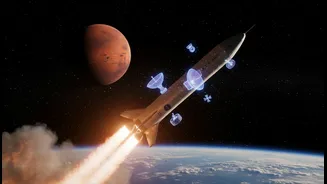
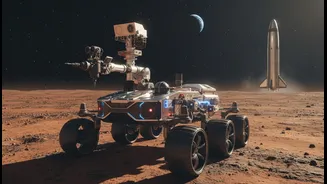
the agency leveraging the innovation and cost-efficiency of the private sector. The idea is simple: let companies like Relativity Space and SpaceX handle the launch and transport, freeing up NASA's resources to focus on the high-end science and instrumentation. This strategy promises to increase the frequency of missions and accelerate discovery. NASA's recently announced Aeolus mission, which will use a Relativity Space rocket to deliver a NASA-built atmospheric sensor suite to Mars in 2028, is a prime example of this model in action. The goal is to gather crucial data to make future landings safer, illustrating a seemingly perfect synergy.
The Great Filter: Landing on Mars
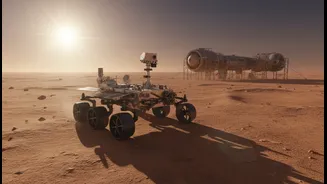
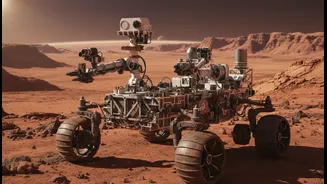
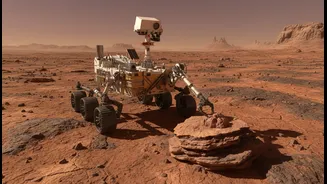
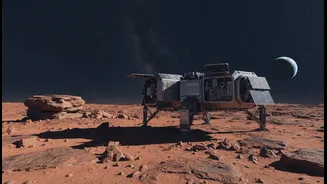
The single greatest challenge, and the one that tempers the excitement around commercial involvement, is Entry, Descent, and Landing (EDL), often called the "seven minutes of terror." Mars has an atmosphere thick enough to burn up an unprotected spacecraft, but about 100 times thinner than Earth's, making parachutes woefully insufficient on their own. Historically, roughly half of all Mars landing attempts have failed. While robotic successes like the Perseverance rover have been remarkable, they are triumphs of bespoke, government-funded engineering. Perseverance weighed about one metric ton. A human-rated lander is projected to weigh between 50 and 100 metric tons. The technologies used to land rovers, like parachutes and the sky crane, simply do not scale to the size and weight needed for a human mission. This isn't a problem private innovation can solve overnight; it's a fundamental physics problem that requires entirely new, yet-to-be-proven technologies like supersonic retropropulsion.
The Tyranny of Distance and Time
Even if landing were solved, the journey itself presents formidable obstacles that fall far outside the typical business case of a commercial provider. The six-to-nine-month trip to Mars exposes astronauts to immense physical and psychological strain. Beyond low Earth orbit, spacecraft are bombarded by galactic cosmic radiation and solar particles, dramatically increasing the risk of cancer, DNA damage, and other diseases. Studies have shown this radiation can be highly damaging to blood-forming stem cells, potentially leading to weakened immune systems and anemia. Furthermore, long-term exposure to microgravity causes muscle atrophy and bone density loss, effects that Mars's one-third gravity may not be sufficient to counteract. The psychological toll of isolation and confinement on a three-year roundtrip mission is another critical factor that requires immense institutional support and research, areas where a government agency like NASA is uniquely positioned to lead.
Where the Private Model Breaks
Private companies excel at innovating within established paradigms and driving down costs for known services, like launching satellites or ferrying cargo to a known orbital address. However, a human Mars mission is not a service; it's a high-risk, multi-decade research and development project with no immediate profit motive. The development of entirely new technologies for EDL, long-term life support, and radiation shielding involves costs and risks that are too high for a commercial entity to bear alone. A single high-profile failure during a private venture could have a devastating ripple effect, impacting public perception, inviting overregulation, and even delaying government programs that rely on shared technology. While companies can iterate quickly on rockets, the fundamental, life-or-death challenges of deep space travel require a patient, publicly funded, and science-driven approach. NASA's traditional role has been to take on the risks that are too great for the private sector, and Mars is the ultimate example of that.