



A Cosmic Neighbour with a Violent Past
Centaurus A has long fascinated astronomers. To the naked eye, it might seem a tranquil object in the southern sky, but telescopes tell a different story. It has a peculiar shape, the result of a colossal collision between a large elliptical galaxy and
a smaller spiral galaxy around two billion years ago. This cosmic merger left behind a distinctive, dark lane of dust that slashes across the galaxy's bright centre, obscuring it from view in visible light. For decades, this dust has hidden the galaxy's most dramatic secrets, acting like a curtain drawn across a chaotic stage. The galaxy is known to be highly active, making it a perfect natural laboratory for studying how galaxies and the supermassive black holes at their hearts grow and evolve.
Webb's Infrared Superpower
This is where the James Webb Space Telescope (JWST) changes the game. While previous telescopes like Hubble gave us beautiful, but limited, views in visible light, Webb is designed to see the universe in infrared. Think of it as having cosmic night-vision goggles. Infrared light has a longer wavelength that can penetrate through the thick clouds of gas and dust that are opaque to visible light. Previous infrared observatories, like the Spitzer Space Telescope, could see the large-scale warm structures, but lacked the sharpness to see fine details. Webb’s unprecedented sensitivity provides both clarity and depth, allowing astronomers to finally pierce the veil of Centaurus A and see the intricate workings of its core, star by star.
A Tapestry of Stars and Dust
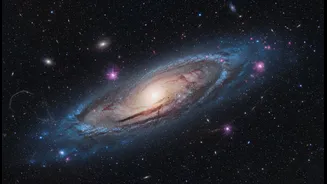
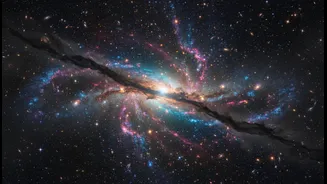
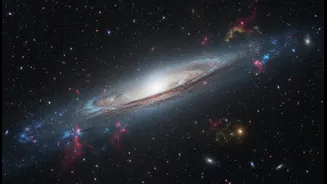
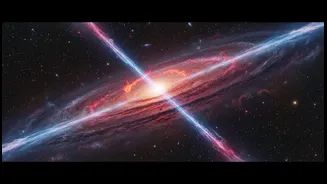
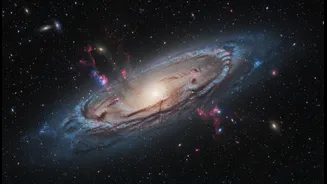
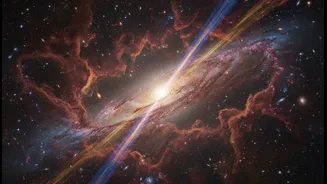
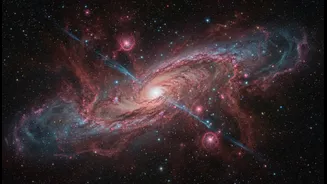
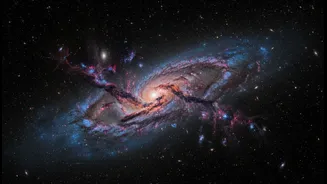
The new images, released to mark the fourth anniversary of Webb's science operations, are breathtaking. What once appeared as a fuzzy glow is now resolved into a dense tapestry of millions of individual stars. Webb’s Mid-Infrared Instrument (MIRI) reveals the dust itself not as a dark shroud, but as glowing, intricate filaments, loops, and clouds of warm material. A strange, parallelogram-shaped band of dust cuts across the centre, while a mysterious S-shaped structure, now seen with startling clarity, hints at the powerful forces at play. The bright red and pink knots scattered throughout are stellar nurseries, where new stars are being born from the raw material left behind by the ancient galactic crash.
The Engine at the Centre
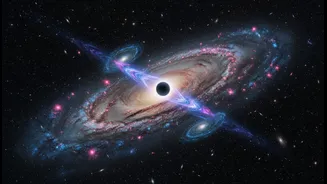
At the heart of all this activity is a supermassive black hole, 55 million times the mass of our sun, that is actively feeding on the surrounding gas and dust. As it feeds, it unleashes enormous amounts of energy, launching powerful jets of material at nearly the speed of light. Webb’s instruments can not only image these structures but also measure the movement of gas around them. Early data shows warm hydrogen gas rotating in a warped disk near the black hole, while other gas is being blasted outwards. This provides a rare, close-up view of the complex relationship between a black hole and its host galaxy, showing how it can both trigger new star formation by compressing gas and shut it down by blowing material away.
Galactic Archaeology in Action
These new observations are more than just pretty pictures; they represent a new era of galactic archaeology. By distinguishing between different generations of stars—those that existed before the merger, those born during the collision, and those formed in its aftermath—astronomers can reconstruct a detailed timeline of the galaxy's turbulent history. Each star is a fossil record, and by studying them, scientists can piece together a more complete understanding of how galactic collisions, starbursts, and active black holes shape the evolution of galaxies across the cosmos. The fresh depth provided by Webb's infrared views transforms Centaurus A from a peculiar object into a vivid, unfolding story of cosmic violence and creation.