



The Challenge of Watching the Void
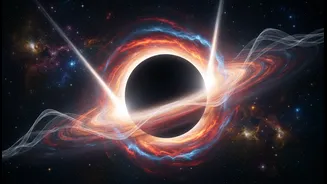
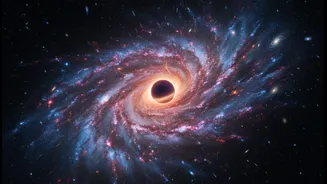
Observing a black hole is a profound challenge. By their very nature, they are invisible, detectable only by the gravitational havoc they wreak on their surroundings. For decades, astronomers have inferred their existence by tracking the frantic orbits
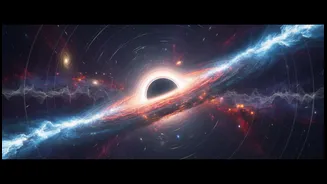
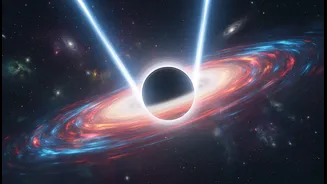
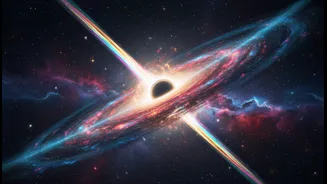
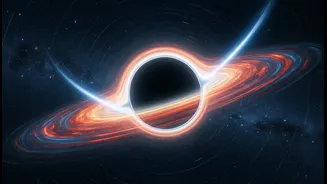
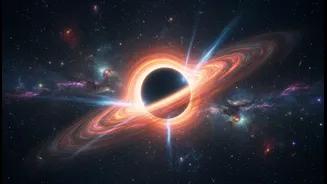
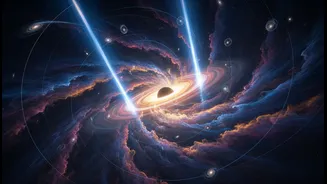
of nearby stars or detecting the faint glow from accretion disks—the swirling platters of superheated gas and dust that form as a black hole pulls in matter. These observations, however, were like looking at static photographs, offering only snapshots of a process that unfolds over cosmic timescales. Seeing the dynamic, moment-by-moment process of a gas cloud actually falling towards a black hole seemed like science fiction. The sheer distance, the obscuring dust of the galactic center, and the immense speeds involved made capturing such an event a monumental task.
A 'Live' Feed From Deep Space
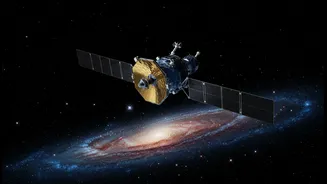
The game-changer has been the development of incredibly sensitive instruments, most notably the GRAVITY instrument at the European Southern Observatory's Very Large Telescope (VLT) in Chile. GRAVITY works through a technique called interferometry, combining the light from four separate 8-meter telescopes to create a single, virtual 'super-telescope' with a diameter of 130 meters. This immense power allows it to cut through the cosmic haze and see details with unprecedented sharpness. This isn't your standard telescope; it's a finely-tuned machine designed specifically to probe the extreme environment around Sagittarius A, the supermassive black hole at the center of our own Milky Way galaxy. Its sensitivity allows astronomers to track flares of infrared radiation from gas clumps orbiting the black hole at staggering speeds—up to 30% of the speed of light. These flares, observed in real time, provide a direct view of the accretion process as it happens.
Witnessing a Galactic Meal
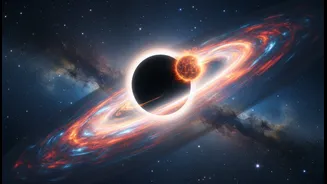
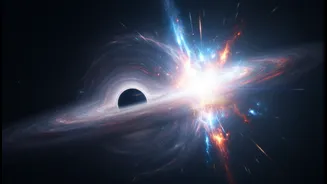
In recent years, astronomers have trained these powerful eyes on several gas clouds, famously named G1 and G2, as they made their perilous journey towards Sagittarius A. These clouds, each with a mass several times that of Earth, were observed accelerating and stretching, a process gruesomely dubbed 'spaghettification', as the black hole's immense gravity pulled them apart. Scientists watched in awe as the front of a cloud, traveling at over 10 million km/h, whipped around the black hole while its tail was still falling in. It was the first time this cosmic shredding was observed in such detail. More recently, a third cloud, G2t, was discovered following a nearly identical orbit, suggesting they all originate from the same source: a massive pair of stars that periodically sheds enormous amounts of gas, which then gets captured by the black hole's gravity.
Why This Changes Everything
Being able to watch a black hole feed in near real-time is more than just an astronomical spectacle; it's a fundamental shift in how we study the universe. It provides direct evidence for theories about how black holes grow and influence their host galaxies. By observing the material just before it crosses the event horizon—the point of no return—scientists can test Einstein's theory of general relativity in the most extreme gravitational field imaginable. These real-time observations move us from a static to a dynamic understanding of the cosmos. We are no longer just mapping the stars; we are watching the messy, violent, and beautiful process of galactic evolution unfold. It's like going from studying a photograph of a waterfall to watching a live video of the churning water.