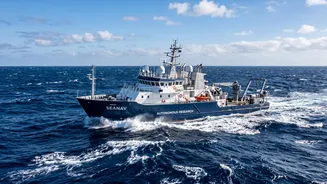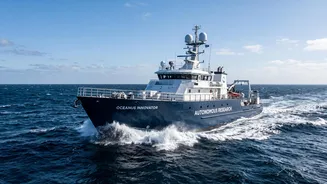




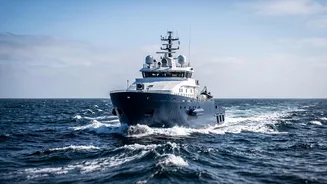
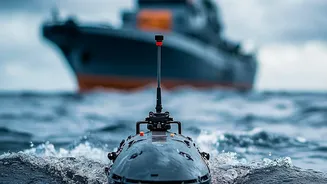
The future of global trade involves massive, autonomous ships navigating the oceans. But how do you test these giants without costly and dangerous real-world trials? An innovative solution from IIT Madras provides the answer.
The Global Race for Autonomous Shipping
The world's economy floats
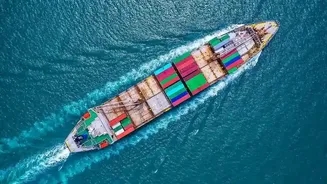
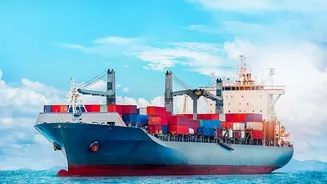
on water. Over 80% of global trade is transported by sea, making maritime shipping a cornerstone of modern commerce. In this high-stakes industry, companies are constantly searching for an edge in efficiency and safety. The next great frontier is autonomy: self-driving ships that promise to reduce human error, lower fuel consumption, and streamline logistics. However, this futuristic vision has a very real and expensive problem. Testing the complex navigation algorithms and artificial intelligence required for a vessel to pilot itself is incredibly challenging. Real-world sea trials are not only prohibitively expensive and time-consuming, but they also carry immense risk. A single error in code could lead to a catastrophic collision, environmental damage, or loss of a multi-million dollar prototype. This testing bottleneck has been a major hurdle slowing the deployment of maritime autonomous surface ships (MASS).
Enter SeaNav: A Virtual Ocean in a Box
Researchers at the Indian Institute of Technology Madras's Department of Ocean Engineering have developed a groundbreaking solution called SeaNav. At its core, SeaNav is a real-time digital twin platform—a highly realistic, high-fidelity virtual maritime world created to test, validate, and train autonomous navigation systems without ever touching water. This 'ocean in a box' allows developers to simulate a vast array of conditions, from calm seas to raging storms, and from empty waters to congested shipping lanes. The project, led by Associate Professor Dr. Suresh Rajendran, leverages a powerful combination of digital twins, AI, advanced sensor fusion, and virtual reality to create a robust and scalable testing environment. This innovation directly addresses the primary obstacles of cost and danger that have hampered the progress of autonomous shipping.
How 'Hazard-Free' Testing Works
The magic of SeaNav lies in its ability to create a 'digital twin' of the maritime world using the Unity3D engine, a sophisticated platform often used for developing video games. This isn't just a simple simulation; it's a dynamic environment that accurately replicates the physics of ocean waves, complex vessel movements, and real-world navigation scenarios. To ensure its accuracy, the simulator was calibrated using a benchmark model of a 320-meter-long tanker vessel, ensuring the results in the virtual world closely mirror what would happen in real commercial shipping operations. Within this virtual space, developers can unleash their autonomous navigation algorithms. They can test how the AI responds to unexpected obstacles, sudden weather changes, or system failures. The platform can simulate multiple vessels at once, testing collision avoidance systems and compliance with maritime rules of the road (COLREGs) in ways that would be far too risky in the real world.
Beyond Cost Savings: The Strategic Advantage
The benefits of a system like SeaNav extend far beyond just reducing the cost and risk of sea trials. Virtual testing allows for a far more comprehensive and rapid development cycle. Algorithms can be subjected to thousands of scenarios in a matter of days, a process that would take years in the physical world. Developers can specifically create rare but high_risk 'edge cases'—like a sudden engine failure in a crowded port—to ensure the autonomous system is robust enough to handle genuine emergencies. This capability significantly accelerates the certification and regulatory approval process, building confidence among stakeholders and international bodies. Furthermore, SeaNav aligns perfectly with national initiatives like the Sagarmala Programme and Maritime India Vision 2030, which champion the adoption of smart port technologies and digital systems to boost India's maritime sector.
From the Lab to Indian Ports and Beyond
The potential applications for SeaNav are vast. Beyond developing fully autonomous ships, the platform can be used to create and validate AI_assisted navigation systems for human crews, helping to reduce the risk of collisions and groundings at major Indian ports like Chennai, Mumbai, and Kochi. Its multi_vessel simulation capabilities also make it a valuable tool for coastal surveillance, planning search_and_rescue operations, and maritime defence applications. By providing a safe and efficient development pathway, SeaNav not only solves a critical industry problem but also positions India as a key innovator in the future of global shipping. It helps create the expertise and technology needed to make the nation's waters smarter and safer.