




The Sun's Hidden Engine
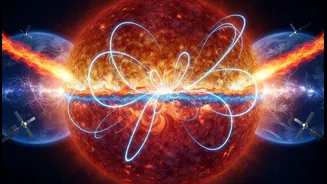
Deep beneath the sun's fiery surface, about 200,000 kilometres down, lies a region of incredible turmoil called the tachocline. It's not a solid layer, but a boundary zone only about 30,000 kilometres thick. Think of it as a cosmic gear box. Above it,
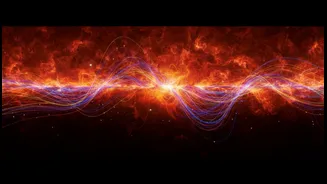
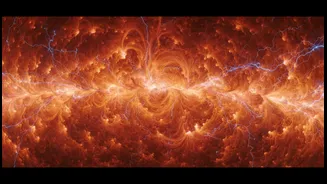
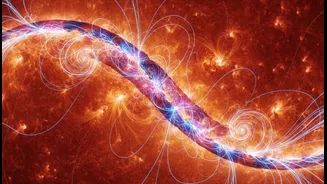
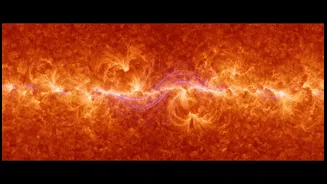
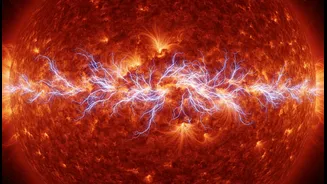
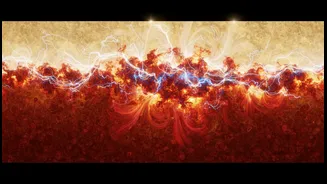
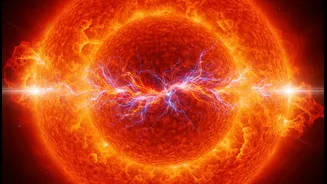
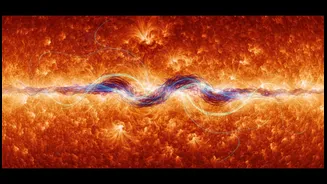
the sun's vast outer layer, the convection zone, boils and churns, with its equator spinning faster than its poles. Below it, the inner radiative zone spins uniformly, like a solid ball. The tachocline is the thin, turbulent interface where these two dramatically different rotation speeds meet. This intense shearing action is believed to be the primary engine of the solar dynamo—the process that generates the sun’s massive and complex magnetic field. It's here that magnetic field lines are thought to be stretched, twisted, and amplified, storing immense energy.
When the Sun Erupts
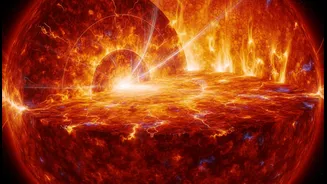
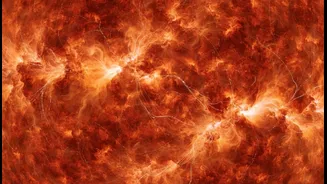
The energy built up in the tachocline doesn't stay there. It eventually becomes buoyant and bursts through the sun's surface, creating sunspots and powerful explosions like solar flares and coronal mass ejections (CMEs). These events fling vast clouds of charged particles and radiation into space. When Earth is in the path of one of these solar storms, the consequences can be severe. Our planet's magnetic field protects us on the ground, but our technology is highly exposed. Intense solar radiation can damage the electronics on satellites, degrade their solar panels, and shorten their operational lifespan. It can also heat the Earth’s upper atmosphere, causing it to expand and create drag that can pull satellites out of orbit.
A Threat to Modern Life
The danger isn't confined to space. Geomagnetic storms, caused by CMEs interacting with Earth's magnetic field, can induce powerful electrical currents in long conductors on the ground. This can overload transformers and destabilise entire power grids, leading to widespread and long-lasting blackouts. These storms also disrupt the ionosphere, the atmospheric layer that radio signals bounce off of. This can degrade or completely block GPS signals and high-frequency radio communications, affecting everything from aviation and shipping to agriculture and emergency services. For astronauts, especially those on future missions to the Moon or Mars beyond the protection of Earth's magnetosphere, the high-energy particles from a solar storm pose a significant radiation risk.
The Forecasting Gap
Currently, our ability to forecast space weather is limited. Agencies like NOAA's Space Weather Prediction Center monitor the sun's surface for active regions and CMEs, giving us a warning that can range from a few hours to a couple of days. This is like forecasting a hurricane only after it has already formed. We can see the storm coming, but we have a limited understanding of the deep forces that created it. This reactive approach leaves us vulnerable to surprise events and makes long-term risk assessment difficult. Improving these forecasts requires moving beyond just observing the surface and understanding the fundamental driver of the activity: the solar dynamo itself.
A New Window into the Sun
This is where the tachocline becomes critical. By studying this deep layer, scientists hope to understand the very origins of the sun's 11-year magnetic cycle. Using techniques like helioseismology, which studies how sound waves travel through the sun, researchers are beginning to map the tachocline's structure and dynamics. Recent advances in computer simulations and machine learning are also helping to model how the shear flows in this region generate and shape the magnetic fields that eventually cause solar storms. The goal is to build predictive models that are based not just on what's happening on the sun's surface, but on the conditions within its magnetic engine room. This could extend our forecasting window and improve the accuracy of predictions, allowing for more time to protect vulnerable systems.