






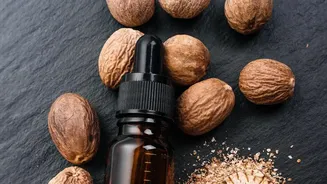

More Than Just a Flavourful Spice
For centuries, nutmeg (Myristica fragrans) has been a prized commodity, not just for its ability to elevate culinary creations, but for its role in traditional wellness practices. In Ayurveda, for instance, it has been used to calm nerves and aid digestion.
This history hints at a deeper complexity within the humble seed. Beyond its comforting aroma lies a rich array of bioactive compounds, chemicals that can interact with the body's systems in various ways. Modern science is now beginning to investigate these compounds, seeking to understand the basis for nutmeg's long-held reputation and examining claims about its impact on everything from mood to memory.
The Key Compounds Within Nutmeg
The distinctive character of nutmeg comes from its essential oils, which are packed with a variety of powerful substances. The most talked-about is myristicin, a compound also responsible for the spice's toxic effects at high doses. Alongside it are elemicin and safrole, which belong to a similar class of chemicals called phenylpropenes. But that's not all. Nutmeg also contains terpenes like sabinene and pinene, which contribute to its aroma, and a wealth of antioxidants, including flavonoids and phenolic compounds. It is this entire chemical symphony, rather than a single component, that defines nutmeg's potential physiological effects.
The Science on Brain Health and Cognition
The link between nutmeg and brain health is a key area of interest. Some research, primarily in animal and lab studies, suggests that compounds in nutmeg may offer neuroprotective benefits. Myristicin, for example, has been studied for its ability to inhibit an enzyme involved in the development of Alzheimer's disease and for preventing the formation of certain plaques seen in the condition. Other compounds, like macelignan, have been shown to help prevent oxidative damage to brain cells in laboratory settings. Furthermore, some animal studies indicate that low-dose nutmeg extract can improve learning and memory, possibly by influencing neurotransmitter activity in the hippocampus, the brain's memory centre. Traditional medicine has long used it as a natural remedy for mental fatigue and to improve focus.
A Source of Anti-Inflammatory Power
Chronic inflammation is increasingly understood as a contributing factor to many long-term health issues, including some neurodegenerative conditions. Nutmeg is rich in anti-inflammatory compounds. Studies have shown that its essential oils, including myristicin and eugenol, can help reduce inflammation markers in the body. This effect is believed to contribute to its traditional use for relieving pain, such as from arthritis or muscle soreness. By potentially reducing systemic inflammation and oxidative stress, these compounds may indirectly support brain health, as a healthy brain relies on a low-inflammation environment to function optimally.
Myristicin: A Double-Edged Sword
It is impossible to discuss nutmeg's effects without focusing on myristicin, its most potent and controversial component. While it may offer some benefits at very low levels, it is also a psychoactive substance and a neurotoxin in large quantities. High doses of nutmeg—well beyond any culinary amount—can cause serious side effects including hallucinations, dizziness, agitation, and dry mouth. These effects are thought to be related to the way myristicin is metabolised in the body, potentially into an amphetamine-like compound. It also has the ability to inhibit certain enzymes in the liver, which can affect how the body processes other substances. This dual nature underscores the importance of moderation.
A Critical Word on Dosage and Safety
The line between a beneficial spice and a harmful substance is purely a matter of dose. All scientific literature agrees that nutmeg is safe in small, culinary amounts, such as a quarter or half teaspoon in a recipe. The toxic threshold is much higher, with adverse neuropsychological symptoms reported after consuming around 10 to 15 grams of nutmeg powder at once. For this reason, concentrated nutmeg oils or extracts should be avoided. Using nutmeg as it has been for centuries—as a gentle flavouring—allows you to enjoy its aromatic qualities without approaching the risk of toxicity. More is certainly not better when it comes to this powerful spice.