

A New Chapter in Cosmic Exploration
On August 30, 2026, the Nancy Grace Roman Space Telescope lifted off from Florida aboard a powerful SpaceX Falcon Heavy rocket, marking the start of a new era in astrophysics. The observatory is now on a three-month voyage to its destination: a gravitationally
stable point in space known as Lagrange Point 2, or L2, located about 1.5 million kilometers from Earth. This mission, named after Dr. Nancy Grace Roman, NASA's first chief of astronomy and the “mother of Hubble,” is not just another telescope; it's a cosmic surveyor designed to tackle some of the biggest questions in science. After a commissioning period, its first images are expected in early 2027, promising a flood of data that could reshape our cosmic map.
The Search for Dark Secrets
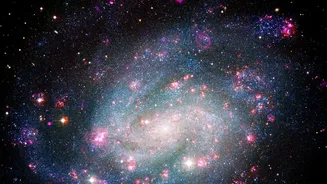
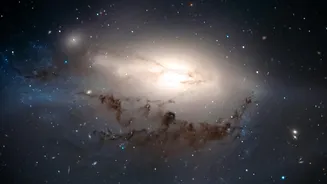
Two of the most profound mysteries in physics are dark energy and dark matter. Together, they are believed to make up about 95% of the universe, yet we know almost nothing about them. Roman's primary mission is to hunt for answers. Dark energy is the mysterious force thought to be causing the universe's expansion to accelerate, while dark matter is the unseen substance whose gravity holds galaxies together. Roman will conduct a massive survey, mapping the structure and distribution of over a billion galaxies across cosmic time. By studying how galaxies and galaxy clusters are spread out and how their light has been distorted on its way to us, scientists can measure the influence of both dark energy and dark matter with unprecedented precision, testing our fundamental understanding of the cosmos.
A Planet-Hunting Powerhouse
Beyond the grand cosmic structure, Roman will also perform the largest census of exoplanets ever attempted. While missions like Kepler and TESS found thousands of planets by watching for the dip in starlight as a planet passes in front of its star, Roman will heavily rely on a different technique called gravitational microlensing. This method detects planets by observing how their gravity, and that of their host star, bends and magnifies the light from a more distant, background star. This technique is sensitive enough to find a wide variety of worlds, from giant gas planets to smaller, rocky ones, and even rogue planets that wander through space without a star to orbit. Scientists anticipate that Roman will discover thousands of new planets, providing a statistical treasure trove to understand planetary system formation across our galaxy.
Hubble's Wide-Angle Cousin
So, how does Roman differ from the famous Hubble and James Webb Space Telescopes? The key is its field of view. Roman's primary mirror is the same size as Hubble's, but its Wide Field Instrument can capture an area of the sky at least 100 times larger in a single snapshot, with the same sharp resolution. Think of Hubble and Webb as zoom lenses, perfect for studying individual objects in incredible detail. Roman, by contrast, is a wide-angle lens designed to create enormous panoramic images of the universe. It will function as a cosmic scout, identifying countless new targets—supernovae, distant galaxies, and strange star systems—that its siblings, Hubble and Webb, can then investigate more closely. This collaborative approach will make all of NASA's observatories more powerful.
Testing Tech for Tomorrow
Riding along with Roman's main camera is a groundbreaking technology demonstration: the Coronagraph Instrument. A coronagraph is designed to block the overwhelming glare of a star, allowing astronomers to directly image the much fainter planets orbiting it. Roman's coronagraph is projected to be at least 100 times more powerful than any previous versions, capable of spotting planets a billion times dimmer than their host stars. While its main goal is to test the technology, it will be able to capture images of Jupiter-sized planets. This instrument serves as a crucial stepping stone for future, even more ambitious missions like the planned Habitable Worlds Observatory, which aims to one day directly image Earth-like planets around other stars.