




The Golden Age of Observation
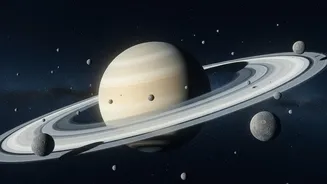
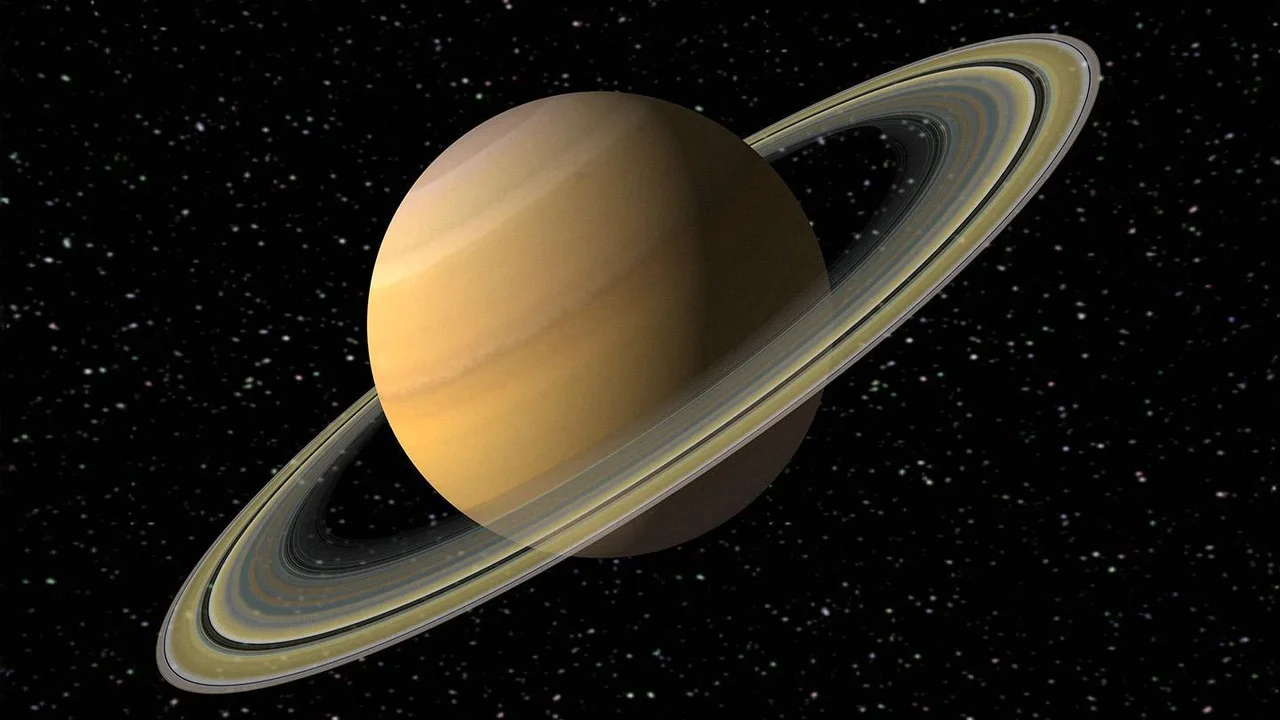
For centuries, finding a new moon was a straightforward, if difficult, task. It required a powerful telescope, a keen eye, and immense patience. Christiaan Huygens started the cosmic collection in 1655 when he first spotted Titan, Saturn's largest moon.
Giovanni Cassini added four more to the list between 1671 and 1684. This method of direct observation, pointing a telescope and looking for points of light moving in orbit around the planet, dominated moon-hunting for over 300 years. The advent of space exploration supercharged this approach. Missions like NASA's Voyager and, most notably, the Cassini spacecraft, which orbited Saturn from 2004 to 2017, allowed for unprecedented close-up views. Cassini alone discovered several new moons, including Methone, Pallene, and Daphnis, simply by being in the right place at the right time.
The 'Shift and Stack' Revolution
Today, most new discoveries aren't made by someone peering through an eyepiece. They’re found buried in massive datasets from powerful ground-based telescopes like the Subaru Telescope in Hawaii. The challenge is that these new moons are often just a few kilometres wide and incredibly faint. To make them visible, astronomers use a powerful computational technique called the “shift and stack” method. It works by taking a sequence of images of a patch of sky where a moon is predicted to be. Because the faint moon moves against the background of stationary stars, simply layering the images would blur it into nothing. Instead, software shifts each image to follow the moon’s expected path. When these shifted images are “stacked” on top of one another, the faint light from the moon adds up, becoming a clear, detectable signal, while the background stars are smeared into long streaks.
Confirming a Cosmic Companion
Spotting a faint dot of light is only the beginning. To be officially recognized as a moon, this candidate object must be tracked over time to confirm it is truly in a stable orbit around Saturn. This crucial step prevents misidentifying passing asteroids or even glitches in the digital data. Astronomers conduct follow-up observations, sometimes for months or years, to precisely map the object's trajectory. Once the orbit is confirmed, the discovery is announced by the International Astronomical Union's Minor Planet Center, the official body for cataloging such finds. This rigorous process ensures that each new addition to Saturn's family is a verified member. In recent years, this technique has led to staggering hauls, including the announcement of 128 new moons in March 2025.
Beyond Direct Sight: Gravitational Clues
Not all moons are discovered by being seen. Some reveal their presence through their gravitational influence on their surroundings. The intricate dance of Saturn’s rings and its other moons can be disturbed by the slight gravitational pull of a hidden satellite. For instance, scientists noticed structures and waves within the rings that could only be explained by the presence of small “shepherd” moons orbiting nearby, some of which were later visually confirmed. In 2008, Cassini data showed a strange depletion of energetic electrons near the moon Rhea, suggesting the possible existence of a tenuous ring system or unseen moonlets orbiting it. This detective work, where effects are seen before their cause, represents another sophisticated tool in the modern astronomer's toolkit, turning the entire Saturnian system into a giant celestial laboratory.