







What is the Ring Nebula?
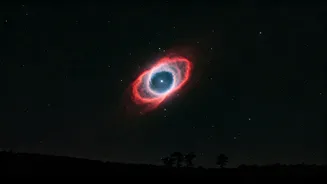
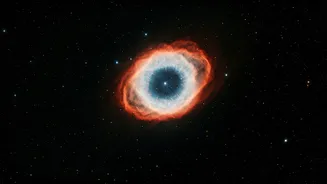
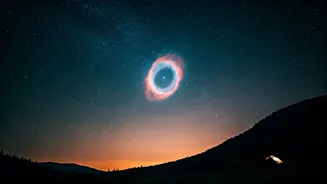
Imagine a star like our sun reaching the end of its life. As it dies, it puffs its outer layers of gas into space, creating a beautiful, expanding shell. At the centre, a tiny, hot core — a white dwarf — illuminates this gas, causing it to glow. This
is the Ring Nebula, also known as Messier 57 (M57). Located about 2,300 light-years away in the constellation Lyra, it looks like a perfect, ethereal smoke ring floating in the blackness of space. It’s a breathtaking glimpse into the life cycle of stars and a favourite target for amateur astronomers because of its distinct shape and beauty.
Best Times and How to Find It
The Ring Nebula is best viewed from India during the summer and monsoon months, from May through September. This is when its home constellation, Lyra, is high in the night sky. To find it, first locate Vega, one of the brightest stars visible. It forms a corner of the famous 'Summer Triangle' along with the stars Deneb and Altair. Lyra itself is a small constellation that looks like a parallelogram of stars attached to Vega. The Ring Nebula is located between the two stars that form the side of the parallelogram opposite Vega. While you can't see the 'ring' with the naked eye, its location is easy to pinpoint once you've found Lyra.
The Right Gear for the Job
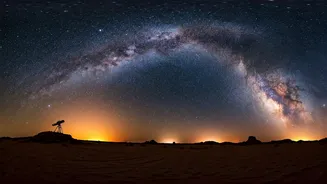
Managing expectations is key: the Ring Nebula is not a naked-eye object. To see it, you will need some optical aid. **Binoculars:** A good pair of 10x50 binoculars can help you scan the area and locate the faint, fuzzy patch of the nebula, but they won't resolve its ring shape. **Telescope:** This is where the magic happens. A small telescope, even a 4- to 6-inch reflector, is powerful enough to reveal the distinct ring shape under dark skies. It will appear as a small, greyish doughnut. Larger telescopes will show more detail and even a hint of colour. **Stargazing Apps:** Apps like Stellarium, SkyView, or Star Walk are invaluable. They use your phone's GPS to create a live map of the sky, making it incredibly easy to identify constellations and navigate to your target.
India's Best Dark Sky Destinations
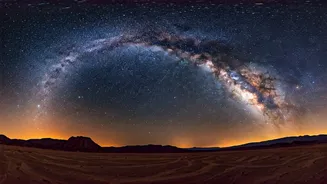
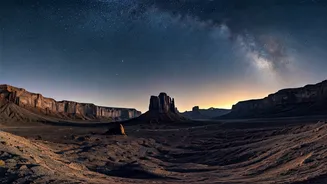
To give yourself the best chance of a clear view, you need to escape light pollution. India has several incredible destinations perfect for a stargazing camping trip. **Hanle, Ladakh:** Home to India's first official Dark Sky Reserve, this is the ultimate destination for serious astronomers. The high altitude and dry, clear air offer pristine viewing conditions. **Spiti Valley, Himachal Pradesh:** Another high-altitude desert, Spiti is renowned for its breathtaking landscapes and ink-black night skies. Villages like Kibber and Langza are popular bases. **Rann of Kutch, Gujarat:** During the Rann Utsav, the vast, flat salt marsh provides an otherworldly backdrop for stargazing. The lack of city lights for miles around creates a massive, dark canvas. **Coorg, Karnataka:** For those in the south, the hills of Coorg offer several estates and campsites away from urban glow. While humidity can be a factor, clear post-monsoon nights are spectacular.
Tips for a Perfect Astro-Camping Trip
A little planning goes a long way. First, check the moon calendar and plan your trip around the New Moon, when the sky is at its darkest. Pack layers of warm clothing, as even summer nights can get chilly, especially at altitude. A crucial piece of kit is a red-light torch; red light preserves your night vision, unlike the harsh white light from a regular torch or phone screen. When you arrive at your spot, give your eyes at least 20-30 minutes to fully adapt to the darkness. Finally, pack snacks, a hot beverage, and a comfortable chair. Stargazing is a patient pursuit, so make yourself comfortable and enjoy the show.