


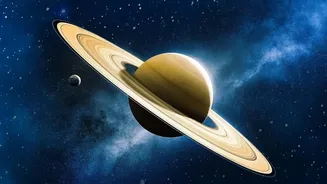
The Great Celestial Headcount
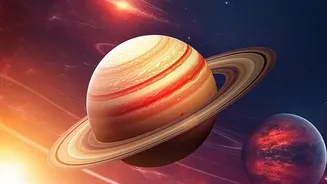
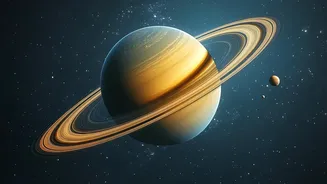
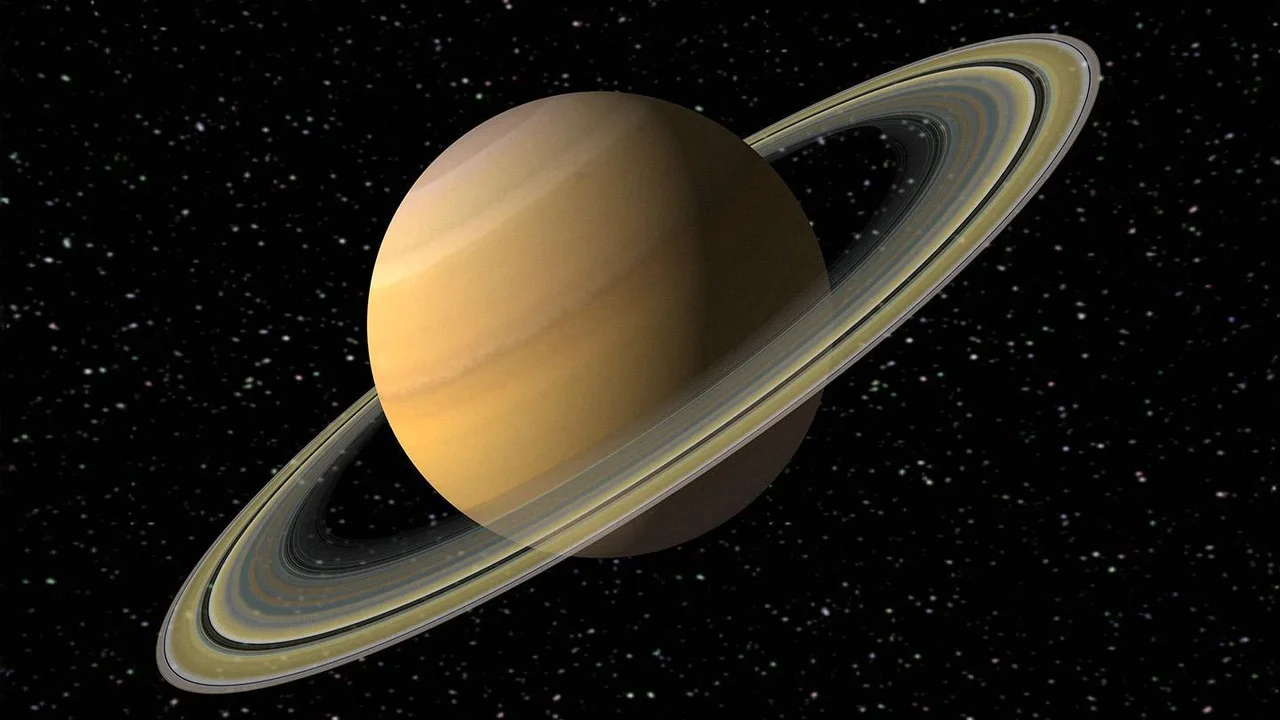
As of mid-2026, Saturn is the undisputed ‘moon king’ of our solar system with a confirmed count that has soared past 290. This figure firmly places it ahead of its rival gas giant, Jupiter, which has a comparatively modest count of just over 100. This cosmic
contest is not just about bragging rights; it's a direct result of incredible technological leaps and the patient work of astronomers. In the past few years alone, Saturn's moon tally has exploded, with over a hundred new satellites being officially recognized in massive batches. One announcement in March 2025 single-handedly added 128 moons to the planet's roster, instantly making countless science textbooks obsolete.
Finding Needles in a Cosmic Haystack
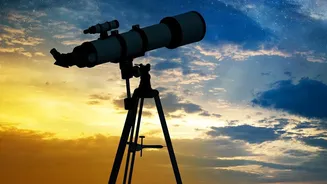
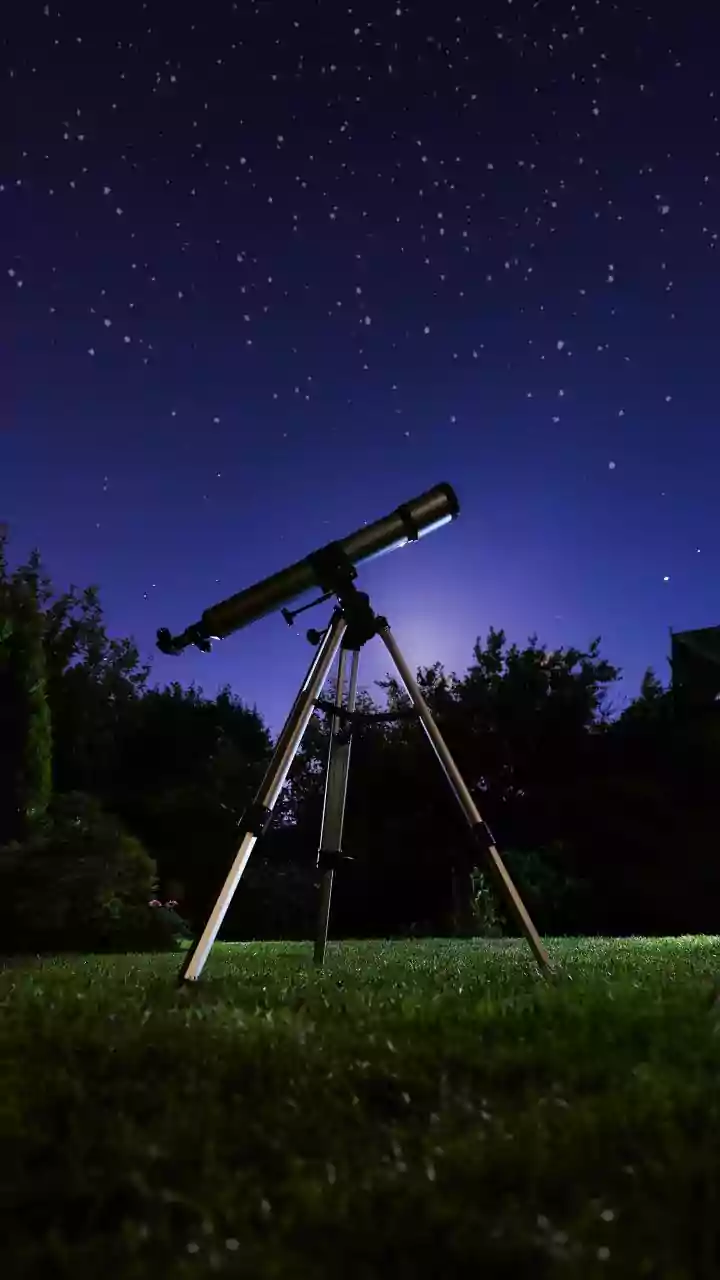
So, how do scientists keep finding these tiny, distant worlds? The process is a testament to modern technology. Most of Saturn’s newly found moons are not giants like Titan, which is larger than the planet Mercury. Instead, they are small, 'irregular' moons, often just a few kilometres in diameter. They are incredibly faint and far from the planet, making them almost impossible to spot. Astronomers use powerful ground-based telescopes, like the Subaru Telescope in Hawaii, to take a series of long-exposure images of the sky around Saturn. They then use a 'shift-and-stack' technique. Knowing the predicted path of a potential moon, they digitally layer the images, aligning them with the moving object. This makes the faint moon appear brighter while the background stars streak, allowing it to be identified.
From 'Candidate' to Confirmed Moon
Spotting a faint dot moving near Saturn is just the beginning. To be officially recognized as a moon, an object must be proven to be gravitationally bound to the planet, not just a passing asteroid. This is where the real patience comes in, and why the number is a 'moving target'. The discovery must be reported to the International Astronomical Union's (IAU) Minor Planet Center, the official body responsible for this cosmic bookkeeping. Astronomers then need to track the object for months, or even years, to precisely map its orbit and confirm it is a stable satellite. The massive batch of 128 moons confirmed in 2025, for example, was the result of observations made between 2019 and 2023. Until this rigorous process is complete, a potential discovery remains just a candidate, not an official moon.
A Family of Captured Fragments
Most of these new discoveries belong to groups of 'irregular' moons. Unlike the large, 'regular' moons like Rhea or Enceladus that orbit in a neat plane around Saturn's equator, these are small, rocky bodies with large, tilted, and often elongated orbits. Many even orbit the planet backwards, in what is known as a retrograde motion. Scientists believe these irregular moons are not native to the Saturnian system. Instead, they are likely former asteroids or other objects that were captured by Saturn’s immense gravitational pull long ago. Many of these moons are clustered in orbital families, suggesting they are fragments of larger moons that were shattered in ancient collisions. Studying their orbits gives us a window into the violent, chaotic history of the early solar system.
What's in a Name?
Once a moon is confirmed, it gets a provisional name, like S/2023 S 51, indicating it's a satellite discovered in images from 2023. Eventually, the discoverers can propose a permanent name to the IAU, which has specific rules. To manage the sheer number of new discoveries, Saturn's irregular moons are named after giants from different mythologies depending on their orbital group: Inuit, Gallic (Celtic), and Norse. This system helps astronomers categorize and make sense of the ever-growing swarm of satellites. While over 200 of Saturn's moons currently remain unnamed, this tradition connects our modern discoveries to ancient stories.