



Reading the Air of Other Worlds
For as long as we have looked at the stars, we have wondered if we are alone. Today, that search has zeroed in on exoplanets — planets orbiting stars other than our Sun. We have found thousands of them, but finding them is just the first step. The real
prize is understanding what they are like. Are they fiery gas giants, barren rocks, or something more like home? The key, scientists believe, lies in their atmospheres. The gases surrounding a planet, its “alien clouds,” can tell us about its temperature, weather, and, most excitingly, whether it might be habitable. These atmospheres contain the chemical fingerprints of a world, and for the first time, we have a tool powerful enough to read them in exquisite detail.
A Revolutionary New Eye on the Cosmos
Enter the James Webb Space Telescope (JWST). While previous observatories like Hubble gave us tantalizing glimpses, JWST represents a quantum leap. Its enormous mirror and unparalleled sensitivity to infrared light are precisely what’s needed to probe distant atmospheres. The primary technique is called transit spectroscopy. When an exoplanet passes in front of its star, a tiny fraction of the starlight filters through the planet's atmosphere. Different gases absorb specific wavelengths, or colors, of this light. By analyzing which colors are missing from the starlight that reaches the telescope, astronomers can deduce exactly which molecules are present in the planet's sky, from water vapor to methane.
From Water Worlds to Salty Skies
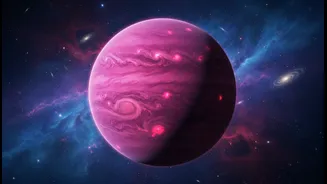
In a remarkably short time, JWST has already delivered a gallery of bizarre and fascinating alien skies. It has confirmed the presence of water vapor, carbon dioxide, and even evidence of photochemistry — chemical reactions sparked by starlight — in the atmosphere of a 'hot Saturn' named WASP-39 b. On a super-Earth called 55 Cancri e, a hellish lava world, the telescope detected an atmosphere likely tied to its molten rock ocean, possibly containing carbon monoxide and carbon dioxide. In another stunning discovery, recent observations of the 'Pink Planet,' GJ504b, revealed something long theorized but never seen: clouds made of salt. And on a cold, Jupiter-like world named Epsilon Indi Ab, Webb found compelling evidence for clouds made of water-ice. These findings are not just a catalog of oddities; they are rewriting our models of how planets form and evolve.
The Ultimate Search for Biosignatures
Beyond understanding planetary weather, this new era of cloud science is directly tied to the search for life. Scientists are looking for biosignatures: gases that are unlikely to exist in large quantities without being produced by living organisms. On Earth, the abundant oxygen is a primary biosignature, constantly replenished by photosynthesis. The simultaneous presence of gases that shouldn't coexist, like methane and oxygen, can be a powerful indicator of biological activity. JWST has already detected methane and carbon dioxide in the atmosphere of K2-18 b, a potential 'Hycean' world with a deep liquid water ocean. While these are not definitive proof of life, as abiotic processes could also be at play, they represent the first thrilling steps on a long journey. The ability to detect these specific chemical combinations is a game-changer.