



An Object of Little Interest
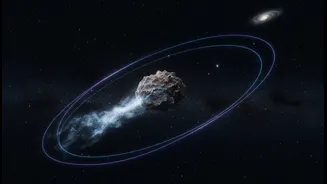
For years, the object designated (248370) 2005 QN173 was just another name in a long catalog of space rocks. Discovered in 2005, it orbits the Sun in the outer part of the main asteroid belt, nestled between Mars and Jupiter. At roughly 3.6 kilometres
in diameter, it was considered a typical, inactive C-type asteroid—a dark, carbonaceous body that has been quietly circling the Sun for billions of years. In a solar system teeming with millions of such objects, there was little to make this one stand out. Astronomers had filed it away as a static, unchanging piece of cosmic furniture, a relic of the early solar system but not one that was doing anything particularly interesting.
A Sudden, Telltale Glow
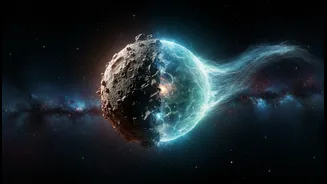
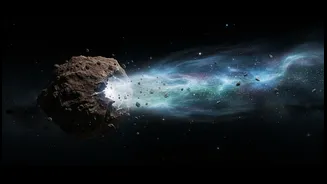
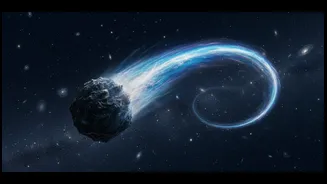
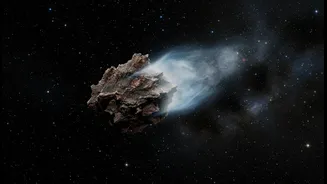
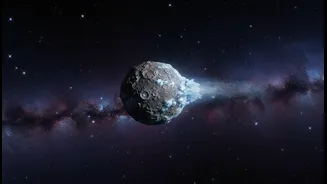
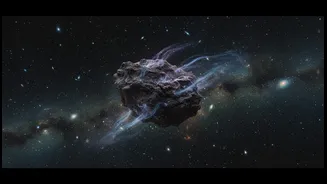
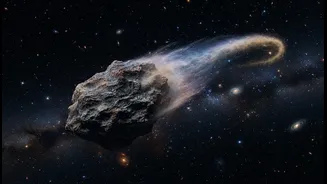
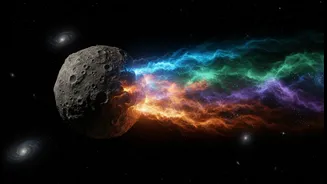
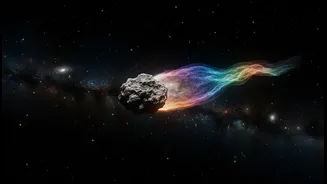
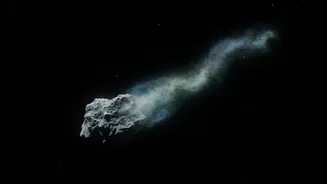
That all changed when recent observations revealed something entirely unexpected. Astronomers using survey telescopes noticed that this supposedly dormant asteroid had sprung to life. The object was sporting a long, narrow tail of dust, a feature characteristic of a comet, not an asteroid. Follow-up studies confirmed the finding, showing a tail of dust and gas stretching hundreds of thousands of kilometres into space. Further digging into archival images showed that the asteroid had actually shown similar activity during a previous close approach to the sun in 2016, but it had gone unnoticed. This recurrent activity is a smoking gun, suggesting that this is not a one-off event like an impact, but a repeatable, intrinsic process.
Blurring the Celestial Lines
This discovery places 2005 QN173 in a rare and fascinating class of objects known as "active asteroids" or "main-belt comets". These celestial bodies have the orbits of asteroids but the physical appearance of comets. The traditional distinction is simple: asteroids are rocky and inert, while comets are icy bodies from the outer solar system that produce spectacular tails when the Sun's heat turns their ice directly into gas—a process called sublimation. Active asteroids like 2005 QN173 challenge this neat division. They orbit within the relatively warm asteroid belt, where scientists once thought any surface ice would have long since vanished. The activity suggests that water ice may be preserved just under the surface, occasionally being exposed and vaporised by the Sun's warmth as the asteroid nears its perihelion, the closest point in its orbit to the Sun.
A Messenger From Our Past
The existence of these hybrid objects is more than just a cosmic curiosity; it has profound implications for understanding our own origins. One of the biggest questions in planetary science is how Earth, which formed in a hot, dry part of the solar system, got its water. While comets from the distant outer solar system were long considered the primary suspects, chemical analysis has shown their water isn't a perfect match for Earth's oceans. Active asteroids in the main belt, however, represent a potential source of water that is much closer to home. These objects could be pristine samples of the water-rich building blocks that were delivered to a young Earth, providing the essential ingredient for life. Studying them gives us a direct window into the composition of the early solar system and the processes that made our planet habitable.