





Spiti: Earth's Natural Observatory
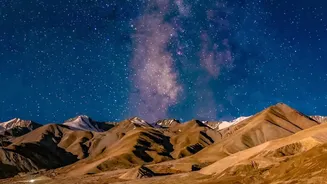
What makes Spiti Valley one of the best stargazing destinations on the planet? It's a rare combination of factors. First, its high altitude, with villages like Langza and Komic sitting above 4,200 metres, places you above a significant portion of the Earth's
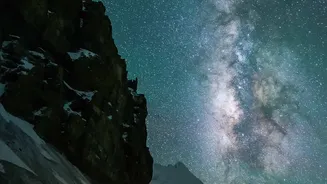
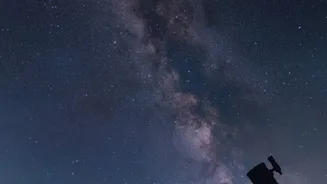
distorting atmosphere. Second, it’s a rain-shadow desert, meaning the air is exceptionally dry with very little cloud cover, even during monsoon season. This results in incredible atmospheric transparency. Finally, its remoteness and sparse population mean there is virtually no light pollution. On the Bortle scale, which measures sky darkness, parts of Spiti are Class 1 — the darkest possible. This combination means that on a clear, moonless night, the Milky Way is bright enough to be seen in stunning detail with the naked eye.
The Core Challenge: A Moving Target
Photographing this spectacle presents a fundamental problem: the Earth rotates. To capture the faint light of distant stars and the Milky Way, your camera needs a long exposure, keeping its shutter open for many seconds, or even minutes. During this time, the Earth's spin causes the stars to appear to move across the sky, creating blurry streaks or 'star trails' in your photo instead of sharp, pinpoint dots. While beautiful in their own right, star trails are not what most astrophotographers are aiming for when they want to capture the galactic core in all its detailed glory. A standard tripod holds your camera still, but it can't compensate for the planet's rotation.
The Solution for Motion: An Equatorial Mount
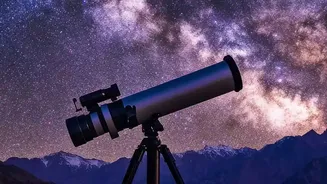
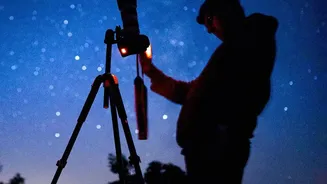
This is where a specialized tripod mount, often called a star tracker or an equatorial mount, becomes essential. Unlike a standard tripod head that pans left-right and tilts up-down, an equatorial mount is designed to align with the Earth's axis of rotation. Once properly aligned (a process called polar alignment), a motor in the mount rotates the camera at the exact same speed as the Earth, but in the opposite direction. This effectively 'freezes' the stars in the frame, allowing you to use much longer exposure times—several minutes if needed—without any trailing. This enables your camera sensor to gather enough light to reveal the faint dust lanes and vibrant colours of the Milky Way with stunning clarity.
Capturing the Scale: The Wide-Angle Lens
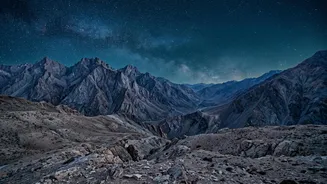
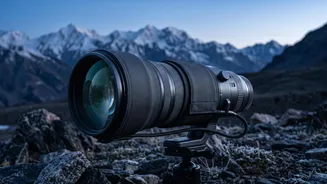
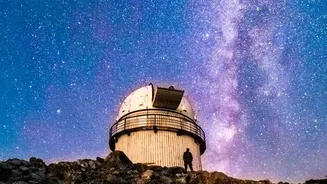
While the tracker solves the problem of motion, a wide-angle lens addresses the challenge of composition. Spiti’s majesty lies not just in its sky, but in the relationship between the cosmos and the dramatic Himalayan landscape below. A wide-angle lens, typically with a focal length between 14mm and 24mm, is crucial for capturing this sense of scale. It allows you to frame a huge portion of the star-filled sky, like the magnificent arch of the Milky Way, while simultaneously including a compelling foreground—perhaps a thousand-year-old monastery, a giant Buddha statue in Langza, or the jagged mountain peaks. Furthermore, a 'fast' wide-angle lens (one with a wide aperture like f/1.8 or f/2.8) is critical for gathering as much light as possible in the shortest amount of time, resulting in cleaner, less noisy images.
Bringing It All Together for the Perfect Shot
In Spiti's cold, thin air, efficiency is key. Batteries drain faster in the cold, and the window for perfect conditions can be short. The combination of an equatorial mount and a fast, wide lens is the winning formula. The mount does the heavy lifting of tracking the sky, ensuring your stars are sharp. This frees up the wide-angle lens to do what it does best: drink in the faint starlight and frame a breathtaking scene that tells the story of this unique place. Without the mount, your exposure times would be too short to do the sky justice. Without the wide lens, you'd miss the epic landscape that makes Spiti's astrophotography so iconic. Together, they are the tools that transform a fleeting visual experience into an unforgettable photograph.