



The Black Hole Size Chart
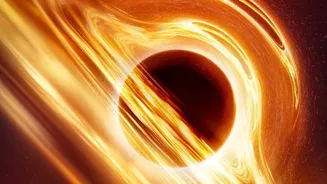
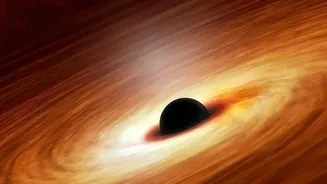
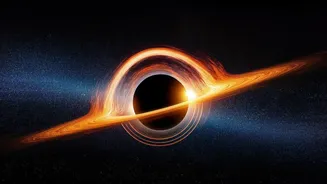
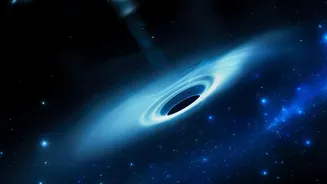
In the cosmic zoo of celestial objects, black holes come in what were once thought to be two main sizes. On one end, you have stellar-mass black holes, typically weighing between five and a few dozen times the mass of our Sun. These form when a single
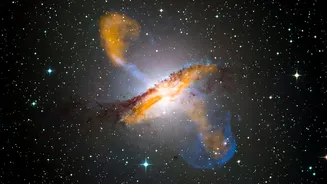
massive star runs out of fuel and collapses under its own gravity. On the other extreme are the supermassive black holes, behemoths that reside at the centre of most large galaxies, including our own Milky Way. These can weigh millions or even billions of times the Sun's mass. For a long time, astronomers were puzzled by the vast gap between these two categories. It was like finding fossils of house cats and elephants, but nothing in between.
The Universe's Missing Middleweights
This gap led to the theory of a third class: intermediate-mass black holes (IMBHs). Ranging from 100 to 100,000 solar masses, these objects were considered the logical 'missing link'. The problem was that they were incredibly difficult to find. They are too massive to be formed from a single star's collapse, yet the environments where they were thought to exist, like dense star clusters, lacked the extreme conditions seen at galactic centres that form supermassive black holes. Traditional telescopes, which look for light or other electromagnetic radiation, struggled to get a confirmed sighting, leaving their existence largely theoretical.
A New Way of Listening
Everything changed with the advent of gravitational wave astronomy. Proposed by Albert Einstein, gravitational waves are ripples in the fabric of spacetime itself, created by the most violent and energetic events in the universe, like the collision of black holes. Observatories such as the Laser Interferometer Gravitational-Wave Observatory (LIGO) and its partners, Virgo and KAGRA, act like giant ears. Instead of seeing the cosmos, they can 'hear' the vibrations from these cataclysmic mergers. This new sense has allowed scientists to detect events that are otherwise completely dark and invisible to us.
A Landmark Collision in Deep Space
A breakthrough came with an event named GW190521. On May 21, 2019, detectors picked up a faint chirp that lasted less than a tenth of a second. Analysis revealed it was the signal from the merger of two enormous black holes, weighing about 85 and 66 times the mass of the Sun. The collision was so powerful that it forged a new black hole with a mass of about 142 solar masses. The remaining 8 solar masses were converted directly into energy, radiated away as gravitational waves. This was a landmark moment: the final product was the first clear detection of an intermediate-mass black hole being born.
Solving the Supermassive Mystery
The detection of IMBHs provides a crucial answer to one of cosmology's biggest questions: How do supermassive black holes get so big, so quickly? The universe is not old enough for them to have grown just by slowly accreting gas and dust. The existence of IMBHs supports the theory of hierarchical mergers. This idea suggests that smaller, stellar-mass black holes merge to form IMBHs, which then act as seeds. These seeds can then merge with other black holes or sink to the centre of a galaxy, eventually growing into the supermassive giants we see today. Observing these intermediate mergers is like finding the fossil of a teenager that links the child to the adult.
The Ultimate Test for Einstein's Theories
These extreme events also serve as a perfect laboratory for testing the limits of Einstein's theory of general relativity. General relativity predicts the exact shape of the gravitational waves produced during a black hole merger, including the final 'ringdown' as the new, larger black hole settles into a stable state. So far, observations like GW190521 have matched Einstein's predictions with incredible accuracy, further cementing his theory of gravity. However, physicists continue to study these signals for any tiny deviation, as that could point toward new physics beyond our current understanding.