



A Sweet Discovery Near the Galactic Center
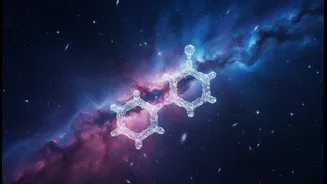
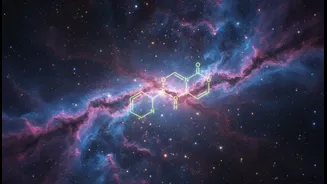
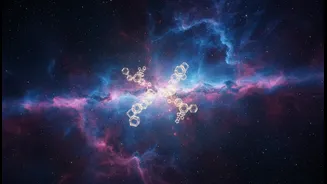
An international team of astronomers has detected a four-carbon sugar called erythrulose in a giant molecular cloud known as G+0.693−0.027, located near the center of our Milky Way galaxy. Here on Earth, this specific sugar is found in things like raspberries.
While scientists have previously found simpler sugars like glycolaldehyde in space and more complex ones like ribose trapped inside meteorites that have fallen to Earth, this marks the first time a sugar of this complexity has been identified floating freely in the interstellar medium. The discovery was made using two powerful radio telescopes in Spain, which allowed researchers to pick up the faint chemical signature, or spectral lines, of the sugar molecule from thousands of light-years away.
Why This Sugar is a Big Deal
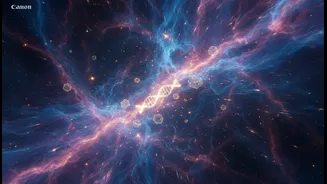
Sugars are fundamental to life as we know it. They form the structural backbone of RNA and DNA, the molecules that carry genetic instructions for all living things. They are also crucial for metabolic processes that power our cells. The big question for scientists has been how these vital molecules first formed on a young Earth. Creating them in labs under early-Earth conditions has proven difficult, leading to a tantalizing theory: what if the key ingredients for life were delivered from space? Discovering erythrulose in interstellar space provides strong evidence for this idea. It shows that complex prebiotic molecules can form in the cold, sparse environment of space, long before planets even exist.
Rewriting the Cosmic Chemistry Rulebook
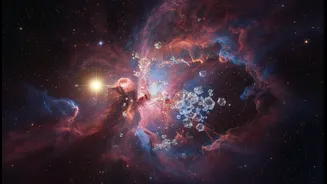
One of the most surprising aspects of the discovery is how the sugar seems to have formed. For a long time, the prevailing theory in astrochemistry was that complex molecules build up sequentially, one carbon atom at a time. However, the team found that erythrulose, a four-carbon sugar, was at least eight times more abundant than any simpler three-carbon sugars in the same cloud. This suggests a different chemical pathway is at play. Researchers now believe that erythrulose likely forms on the surface of icy dust grains, where simpler, two-carbon molecules merge together. These cosmic dust grains act as tiny chemical factories, where the extreme cold and radiation of space drive reactions to create larger, more complex structures.
From a Gas Cloud to the Origins of Life
The existence of this sugar so far from Earth has profound implications. It suggests that the chemical building blocks of life are not unique to our solar system but could be common throughout the galaxy. Scientists estimate that during a period of intense asteroid and comet impacts known as the Late Heavy Bombardment around four billion years ago, millions of tonnes of erythrulose could have been delivered to the early Earth. While erythrulose itself isn't a direct part of our DNA, it can be easily converted into other biologically crucial sugars. This cosmic delivery could have seeded the young planet with a rich supply of the raw materials needed to kickstart the first metabolic and reproductive processes, ultimately leading to life.