


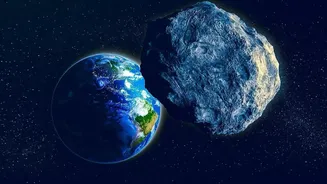
For as long as we’ve looked up, Earth has had one constant companion: the Moon. But what if we told you our planet is currently hosting a second, secret moon? A tiny asteroid, 2026 QQ8, is its name, and its time with us is almost up.
Meet Earth's Temporary Visitor
In the vastness of
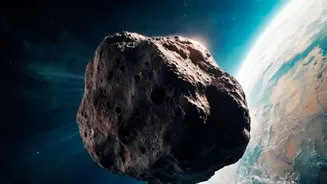
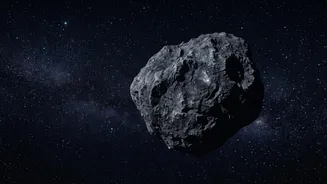
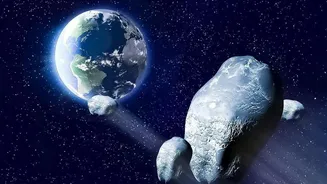
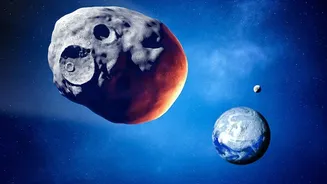
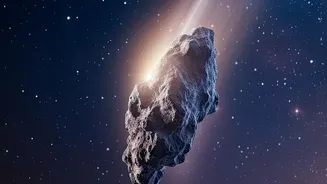
space, our planet is not as alone as we might think. While the Moon is our only permanent natural satellite, Earth occasionally collects tiny companions. The latest of these is a small asteroid named 2026 QQ8. Measuring just about two metres across—roughly the size of a large appliance—this space rock was captured by Earth’s gravity back in April 2026. Since then, it has been tracing a wide, looping path around our planet, earning it the unofficial but endearing title of a 'mini-moon'. First spotted in August by Hungarian astronomer Krisztián Sárneczky, it took several weeks of observation to confirm that 2026 QQ8 was a natural object and not a piece of old space debris. Now, this temporary friendship is nearing its end, as the asteroid is expected to break free from Earth's orbit in early December.
The Science of Mini-Moons
How exactly does a planet like Earth acquire a second, temporary moon? The phenomenon relies on a delicate gravitational dance. These mini-moons, officially called Temporarily Captured Orbiters (TCOs), are typically near-Earth asteroids whose own orbits around the Sun are very similar to our planet's. When one of these asteroids approaches Earth at a relatively low speed, it can get caught in the combined gravitational pull of the Earth and the Moon. Instead of flying past, it's drawn into a complex, unstable orbit. Think of it like a celestial traveler getting briefly pulled into a local side road before rejoining the main highway. These orbits are chaotic and unpredictable, influenced by the Sun, Earth, and Moon, preventing these mini-moons from staying for long.
A Farewell Trajectory
The same gravitational forces that capture a mini-moon are also responsible for its departure. Unlike our large Moon, which is in a stable, long-term orbit, mini-moons like 2026 QQ8 are only weakly bound to Earth. After a few chaotic loops, the gravitational tug from the Sun and Moon eventually sling-shots the asteroid back out of Earth's sphere of influence. Once it escapes, 2026 QQ8 won't disappear forever. It will simply resume its own independent orbit around the Sun. Its path will continue to bring it into Earth's cosmic neighborhood in the future, with another notable pass predicted for 2058, though from a much safer distance. This cycle of capture and release is a normal part of our solar system's mechanics, a constant reminder of the dynamic environment we inhabit.
A Celestial Visitor, Not a Threat
The idea of an asteroid orbiting Earth might sound alarming, but 2026 QQ8 poses absolutely no threat to our planet. Even at its closest approach during its capture phase, it was significantly farther away than our own Moon. Its small size is another key factor. Experts note that even if an object of this size were to enter our atmosphere, it would safely break up into a bright meteor, creating a spectacular light show but causing no harm on the ground. The study of these mini-moons is incredibly valuable for scientists. They provide a rare opportunity to study near-Earth asteroids up close without the immense cost and challenge of launching a deep-space mission.
Are There Others Out There?
While the discovery of a mini-moon is always exciting, it's not as rare as you might think. Scientists estimate that at any given time, there is likely at least one mini-moon at least one meter in diameter orbiting Earth. Most are simply too small, faint, and fast-moving to be detected by current surveys. However, as telescope technology improves, such as with the forthcoming Vera Rubin Observatory in Chile, astronomers expect to find many more of these fleeting companions. The story of 2026 QQ8 joins that of other known temporary satellites like 2006 RH120 and 2020 CD3, each offering a brief glimpse into the hidden population of objects journeying through our corner of the solar system.