




The fear that Artificial Intelligence will lead to mass unemployment is widespread, but a closer look at Gartner's 2030 forecast reveals a more nuanced story. It's not about universal replacement, but a fundamental transformation of job roles.
The Real Numbers: More Jobs Gained Than Lost
Contrary
to the dystopian narrative of robots taking over, recent analysis from technology research firm Gartner offers a more optimistic, albeit complex, forecast. By 2030, AI is projected to create 10.6 million jobs globally while eliminating 8.9 million, resulting in a net gain of 1.7 million jobs. This challenges the simplistic idea of a 'job apocalypse'. The data suggests that while displacement is a real factor, it's overshadowed by job creation and evolution. According to Gartner, organisations at the forefront of AI adoption see it not as a tool to simply replace labour, but as a catalyst to reinvent their operations entirely. The real story isn't about the number of jobs disappearing, but about how many will fundamentally change.
Transformation Over Termination
The most significant impact of AI won't be outright job loss, but widespread job transformation. Gartner estimates that just over 20% of the global workforce, or about 435.5 million employees, will need to adapt to a new shape of work. This means their day-to-day responsibilities, workflows, and skill requirements will evolve. The focus is shifting from automation, which replaces human effort, to augmentation, which enhances it. Think of how spreadsheet software changed the accounting profession; it didn't eliminate accountants but instead freed them from manual calculations to focus on higher-value analysis and strategy. AI is expected to have a similar effect, handling repetitive tasks and allowing humans to concentrate on areas requiring critical judgment, creativity, and context.
Which Sectors Will See the Biggest Shifts?
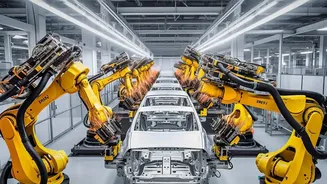
The impact of AI will not be uniform across all industries. Gartner's forecast highlights significant differences between sectors. The technology industry itself, despite having high exposure to AI, is expected to see a net increase of 1.5 million jobs by 2030, with 1.9 million created and only 400,000 lost. Asset-intensive industries, like manufacturing, are predicted to have a relatively balanced outcome, with 6.4 million jobs created and 6 million eliminated. The public sector, however, is projected to face a net loss of 500,000 jobs, as AI investment may not be sufficient to offset other skills shortages. This uneven distribution means that workforce strategies must be tailored to specific industry contexts rather than applying a one-size-fits-all approach.
The Rise of the 'AI-Assisted' Professional
As AI becomes a collaborator, the skills that are most valuable are shifting. The future belongs to the 'AI-assisted' professional who can effectively work alongside intelligent systems. Gartner emphasizes that skills like change agility and digital dexterity—the ability to adapt to and integrate new technologies—are becoming 'evergreen' capabilities. The value is moving away from performing routine tasks and toward problem formulation, strategic foresight, and human-AI mediation. Professionals who combine their domain expertise—whether in finance, marketing, or law—with an understanding of AI will become indispensable. The advantage isn't just knowing how to use an AI tool, but knowing what to ask of it and how to interpret the results with human judgment.
Don't Prepare for a Layoff, Prepare for a Remix
A key takeaway from Gartner's analysis is the risk for companies that are too quick to cut staff. The firm warns that executives using AI purely as a cost-cutting tool risk making reductions that are 'too deep and too soon', only to find they need to rehire those same skills at a higher cost later on. In fact, Gartner predicts that by 2029, 30% of employees laid off due to AI replacement will need to be rehired. This points to the need for a 'talent remix' strategy, where companies focus on reskilling and redirecting workers from automatable tasks to new opportunities. For the individual professional in India, this means proactive and continuous learning is not just advisable; it's essential for long-term career resilience in an AI-augmented world.