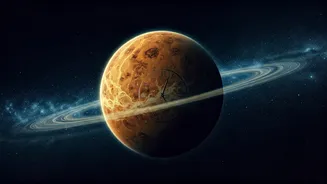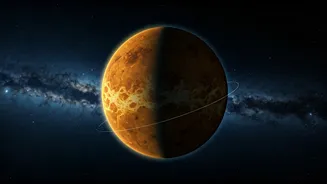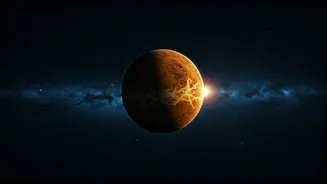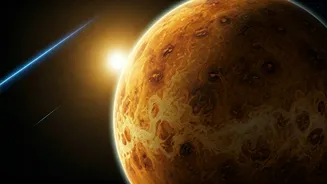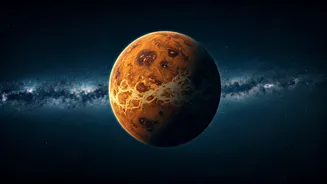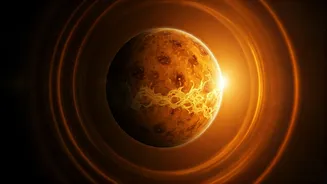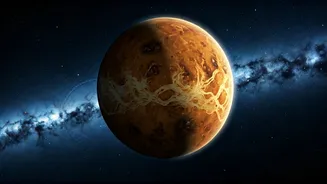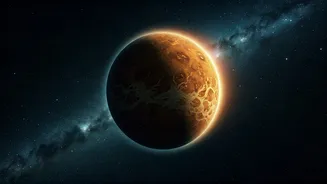




A Day Longer Than a Year
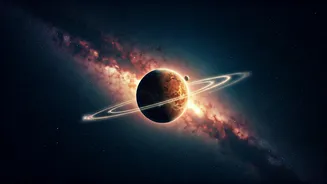
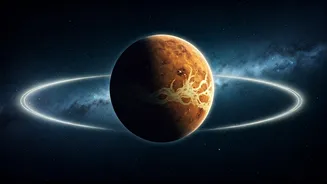
Let’s break down this cosmic riddle with some numbers. A 'year' is the time a planet takes to complete one orbit around its star. For Venus, this journey around the Sun takes about 225 Earth days. In contrast, a 'day' is the time a planet takes to complete one full
rotation on its axis. On Venus, this single spin takes a stunning 243 Earth days. So, if you were standing on Venus, you would celebrate your New Year's Day before you even finished a single day-night cycle. It's a concept that completely upends our Earth-based intuition, where our 24-hour day fits neatly into our 365-day year about, well, 365 times. On Venus, the year is over before the day is done, making it one of the most peculiar places in our solar system.
The Secret in its Slow, Backward Spin
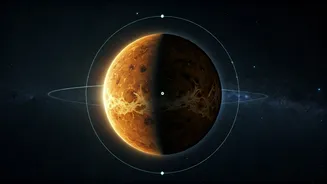
The key to this temporal oddity is Venus's rotation. Not only is it incredibly slow, but it's also retrograde, meaning it spins in the opposite direction to Earth and most other planets in our solar system. While we spin counter-clockwise (if viewed from above the North Pole), Venus spins clockwise. This has a profound effect on its solar day—the time from one sunrise to the next. Because the planet is slowly spinning backward while moving forward in its orbit, one sunrise-to-sunrise cycle on Venus actually takes about 117 Earth days. So while its axial spin (sidereal day) is 243 Earth days, the experience of a 'day' in terms of light and dark is shorter. Still, both measures are extraordinarily long and contribute to the planet's extreme conditions. The sun on Venus rises in the west and sets in the east, another disorienting feature of this alien world.
Why is Venus So Strange?
Scientists don't have a single, definitive answer for Venus's strange behaviour, but there are a few leading theories. One popular hypothesis suggests that in the chaotic early days of the solar system, Venus was struck by a massive planet-sized object. Such a cataclysmic impact could have dramatically altered its original spin, slowing it down to a crawl and even flipping its rotational direction. Another compelling theory points to Venus's incredibly thick atmosphere. The planet's atmosphere is about 90 times denser than Earth's, creating immense pressure. Over billions of years, powerful atmospheric tides, driven by solar heating, could have acted as a brake, gradually slowing the planet's rotation and eventually causing it to spin in reverse. It's possible that a combination of these factors—an ancient collision and powerful atmospheric friction—worked together to create the planetary anomaly we see today.
A Slow-Motion Hothouse
This incredibly slow rotation isn't just a quirky fact; it's a critical component of what makes Venus a living hell. The long solar day means that the side of the planet facing the Sun bakes for months on end. This prolonged exposure, combined with a dense atmosphere composed almost entirely of carbon dioxide, has triggered a runaway greenhouse effect. Heat gets trapped and cannot escape, raising surface temperatures to an average of 465 degrees Celsius—hot enough to melt lead. The surface pressure is a crushing 92 times that of Earth at sea level, equivalent to being nearly a kilometre deep in our ocean. The sky is perpetually overcast with clouds made of sulfuric acid. This extreme environment, directly linked to its strange relationship with time, makes Venus the hottest planet in the solar system, even though Mercury is closer to the Sun.