


Seeing the Universe's Hidden Heat
Infrared light is a type of electromagnetic radiation with longer wavelengths than the visible light our eyes can detect. We can't see it, but we can often feel it as heat. Every object in the universe, even incredibly cold ones, emits some amount of heat,
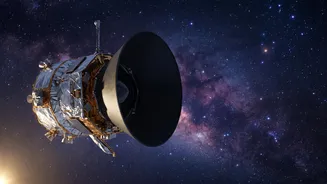
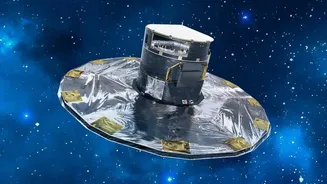
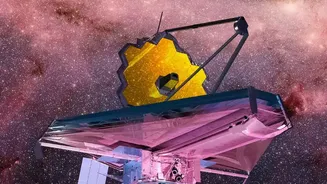
and therefore, infrared radiation. This simple fact is revolutionary for astronomy. Telescopes designed to detect infrared light, like NASA's James Webb Space Telescope (JWST) and the now-retired Spitzer Space Telescope, can perceive the heat signature of objects that are too cool or faint to shine in visible light. This opens up a 'hidden' universe, allowing us to study celestial bodies that would otherwise remain completely unknown.
Meet the 'Failed Stars'
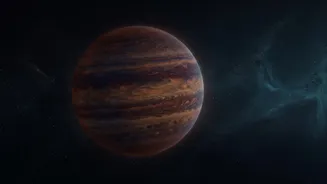
Among the most intriguing objects revealed by infrared are brown dwarfs. Often called 'failed stars', these celestial bodies are in a class of their own. They form like stars from the gravitational collapse of gas clouds but never become massive enough—typically between 13 and 80 times the mass of Jupiter—to ignite the sustained hydrogen fusion that makes stars shine. After an initial, brief phase of deuterium (or 'heavy hydrogen') fusion, they spend the rest of their existence slowly cooling and fading, like dying embers. Because they are relatively small, cool, and dim, they emit very little visible light, making them nearly impossible to find with traditional optical telescopes. They glow faintly in the infrared spectrum, making them prime targets for infrared astronomy.
The Perfect Tool for a Cool Subject
Since brown dwarfs are defined by their low temperature, infrared light is the perfect tool to study them. While they are dim visually, their heat-based infrared glow can be readily detected. By analysing the infrared light from a brown dwarf, scientists can deduce crucial information about its temperature, mass, age, and even the composition of its atmosphere. Recent observations with the JWST have pushed the boundaries of discovery, identifying brown dwarfs as small as just two times the mass of Jupiter. These discoveries challenge existing theories about star formation and blur the line between giant planets and the smallest stars. Some of these tiny brown dwarfs even show signs of having their own disks of material, suggesting planets could form around these 'failed stars'.
Piercing Through Cosmic Dust
Beyond cool objects, infrared light has another superpower: it can penetrate the vast clouds of cosmic dust and gas that are spread throughout space. These dense clouds act like a cosmic fog, blocking and scattering shorter-wavelength visible light. This makes it impossible for optical telescopes to see what's inside or behind them, such as the centres of galaxies or regions where new stars are being born. However, the longer wavelengths of infrared light can pass through this dust largely unhindered. This gives astronomers a clear view into stellar nurseries, revealing the processes of star and planet formation that were previously obscured. It also allows us to see the star-shrouded supermassive black hole at the center of our own Milky Way galaxy.
Looking Back to the Dawn of Time
Perhaps most profoundly, infrared light allows us to look back at the earliest moments of the universe. Because of the constant expansion of the universe, light from the most distant objects gets stretched as it travels across space. This phenomenon, known as 'cosmological redshift', shifts the light's wavelength towards the red end of the spectrum and, for the most ancient galaxies, all the way into the infrared. The visible and ultraviolet light emitted by the first stars and galaxies billions of years ago has traveled for so long that it now reaches our telescopes as infrared radiation. Telescopes like the JWST were specifically designed as infrared instruments to capture this ancient light, allowing scientists to study the formation of the very first galaxies and unlock secrets about the dawn of the cosmos.