





A Planet of Intense Speculation
K2-18b has captured the public imagination for good reason. It’s a ‘sub-Neptune,’ larger than Earth but smaller than Neptune, and it orbits within its star’s habitable zone, where liquid water could potentially exist. Observations from the James Webb
Space Telescope (JWST) have added fuel to the fire, detecting methane and carbon dioxide in its atmosphere. These findings have led some scientists to classify it as a potential 'Hycean' world—a planet with a hydrogen-rich atmosphere over a globe-spanning ocean. Most tantalizingly, some analyses of the JWST data hinted at the presence of dimethyl sulfide (DMS), a gas that, on Earth, is overwhelmingly produced by microbial life. However, this DMS detection remains highly debated, with other teams of scientists arguing the signal isn't strong enough to be conclusive.
Asking Two Different Questions
The intense interest in K2-18b has prompted scientists to ask two fundamental, yet distinct, questions. The first, which the JWST is designed to answer, concerns the planet’s climate and composition: What chemicals make up its atmosphere, and could it support life as we know it? This involves studying the light from its parent star as it filters through the planet's atmosphere. The second question is even more profound: Is there intelligent life there, actively trying to make its presence known? Answering this requires a completely different approach. Instead of looking for the chemical fingerprints of a habitable environment, scientists must listen for the deliberate, structured signals of technology. This is the domain of radio astronomy.
Tuning In for a Cosmic Signal
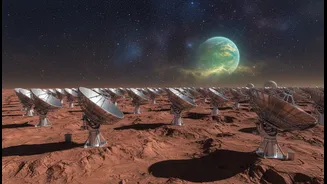
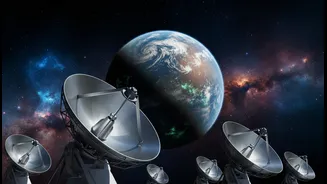
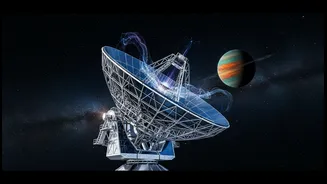
Recently, a team of researchers conducted one of the most extensive searches for so-called 'technosignatures' ever focused on the K2-18 system. Using two of the world's most powerful instruments—the Very Large Array (VLA) in the United States and the MeerKAT radio telescope in South Africa—they listened intently for any artificial radio transmissions coming from the planet. For 33 days, the telescopes scanned a wide range of frequencies, hoping to catch a narrowband signal that would stand out from the natural cosmic background noise. Such a signal would be a tell-tale sign of technology, as natural astronomical phenomena tend to emit radio waves across a broad spectrum.
A New Toolkit for Finding a Needle in a Haystack
The biggest challenge in any modern search for extraterrestrial intelligence (SETI) isn't the distance, but the noise. Our own planet is awash with radio signals from mobile phones, satellites, and broadcasting, creating a massive haystack of interference. The true innovation of this new survey lies in the sophisticated software framework built to sift through this data. The team developed a multi-stage filtering pipeline to identify a true anomaly. First, the system automatically masked any signals matching known Earth-based frequencies. Next, it looked for a 'Doppler drift'—a slight, predictable change in frequency caused by the relative motion of our planet and K2-18b. Any real signal from the exoplanet would exhibit this drift, while local interference would not. Finally, a clever technique called multi-beam analysis was used, where telescopes pointed one beam at K2-18b and others at empty sky nearby. A genuine signal would only appear in the K2-18b-focused beam, whereas interference from Earth would likely bleed into all beams at once.
The Sound of Silence (And Why It Matters)
After processing millions of potential signals, the final result was silence. The survey found no convincing evidence of technosignatures emanating from K2-18b. While not the blockbuster discovery some might have hoped for, this 'null result' is incredibly valuable. It allows astronomers to place an 'upper limit' on the strength of any technology that might be there. Essentially, it tells us that if a civilisation exists on K2-18b, it is not broadcasting powerful, targeted signals in our direction within the frequencies that were checked. Furthermore, separate radio observations of the host star, K2-18, show that it is remarkably quiet and stable. This low stellar activity is good news, as it means the planet’s atmosphere is less likely to be blasted away, making it a more stable environment for any potential life.