





A Mission of Firsts
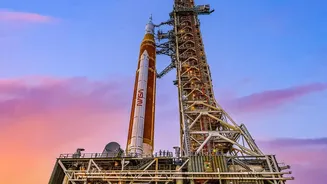
In April 2026, NASA's Artemis II mission successfully sent four astronauts on a ten-day journey around the Moon and back, marking humanity's first crewed voyage into deep space since the Apollo era ended in 1972. While primarily a test flight for the Orion
spacecraft and its life support systems, the mission also had significant scientific objectives. For nearly seven hours during the lunar flyby, the crew—Commander Reid Wiseman, Pilot Victor Glover, and Mission Specialists Christina Koch and Jeremy Hansen—became the first humans to see the far side of the Moon with their own eyes, acting as highly trained geological observers. Their task was to document the lunar surface, providing a human perspective to complement decades of robotic data.
The Moon's Muted Rainbow
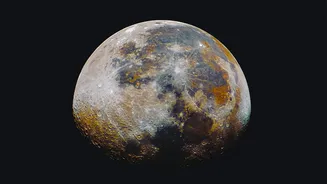
One of the most captivating findings from the crew's observations was the confirmation of the Moon's varied colour palette. Far from a monochrome grey, the astronauts reported seeing a spectrum of subtle hues including brown, tan, white, and even shades of blue and green. Astronaut Christina Koch was particularly struck by the Aristarchus Plateau, a volcanic region on the near side, describing it as having a distinct yellow hue, like a 'jaundiced cheek of the Moon'. Canadian astronaut Jeremy Hansen noted brownish and greenish hues near the massive Orientale basin. These observations, captured in over 800 gigabytes of newly released data, bring a vital human element to our understanding of the lunar landscape.
Reading a Geologic Story
These colours are more than just a beautiful sight; they are direct clues to the Moon's violent and complex geological history. Scientists can interpret these hues to understand the composition of the lunar surface. For example, bluish tones often indicate areas rich in titanium and iron, characteristic of certain volcanic lava flows. Greenish shades can point to the presence of olivine or volcanic glass beads, formed when molten rock from ancient eruptions cooled rapidly. Orange and brown shades suggest different concentrations of iron and titanium, revealing a diverse mineral history across different regions. By mapping these colours, scientists can trace ancient lava flows and understand the processes that shaped the Moon billions of years ago.
The Human Advantage in Space
While robotic probes like the Lunar Reconnaissance Orbiter (LRO) have been mapping the Moon's surface for years, the human eye offers a unique advantage. A trained astronaut can spot anomalies, perceive subtle textural and colour shifts, and provide descriptive context in a way that automated systems cannot. The Artemis II crew, for instance, observed and documented five impact flashes from small meteoroids hitting the lunar surface—transient events that are difficult for cameras to capture but easily noticed by a dark-adapted human eye. The science team on the ground was ecstatic, as these were likely the faintest such flashes ever seen. The crew's detailed verbal descriptions and handheld photography now provide 'ground truth' for satellite data, helping scientists refine their interpretations.
Paving the Way for Our Return
The scientific insights from Artemis II are not just academic. They are crucial for planning the next stages of lunar exploration, including Artemis III, which aims to land astronauts near the Moon's South Pole. Understanding the mineral composition through colour helps identify potential resources, a concept known as in-situ resource utilization. Areas rich in ilmenite, a titanium-iron oxide identified by its bluish tint, are particularly valuable as they could be mined for oxygen and metals—essential components for a sustainable human presence on the Moon. The detailed observations of surface features, especially along the 'terminator' line between lunar day and night, also help NASA select safe and scientifically interesting landing sites for future missions.