



A New Star Appears
In early October 1604, sky-watchers across Europe, China, and Korea noted the sudden appearance of a brilliant point of light in the constellation Ophiuchus. This 'new star' was so bright that it outshone all other stars and even the planet Jupiter. For
more than three weeks, it was visible even during the daytime, causing widespread excitement and debate. At a time when the heavens were believed to be perfect and unchanging, this dramatic celestial event challenged long-held philosophical and scientific beliefs.
The Role of Johannes Kepler
The event is named after the German astronomer Johannes Kepler, though he was not the first person to see it. Bad weather prevented his initial observations, but once the skies cleared, Kepler began a meticulous study of the new star, tracking it for over a year until it faded from naked-eye view in 1606. He published his extensive findings in a book titled 'De Stella nova in pede Serpentarii' ('On the New Star in Ophiuchus's Foot'). His detailed work, completed without the aid of a telescope which had yet to be invented, was so thorough that the supernova has carried his name through history.
A Violent Stellar Explosion
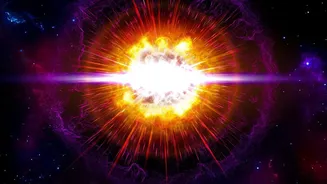
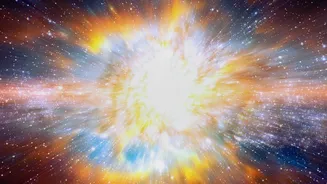
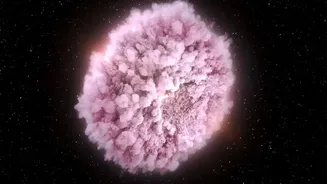
What Kepler and his contemporaries witnessed was not the birth of a star, but the violent death of one. Modern astronomers have identified SN 1604 as a Type Ia supernova. This type of cataclysmic event occurs in a binary star system, where two stars orbit each other. One of these stars is a white dwarf—the tiny, super-dense remnant of a sun-like star. Over time, the white dwarf's immense gravity pulls material from its companion star. When the white dwarf accumulates too much mass, it reaches a critical point, triggering a runaway thermonuclear explosion that completely obliterates it.
The Remnant We See Today
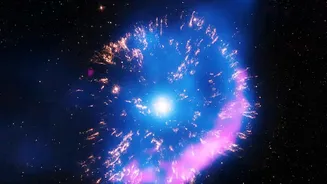
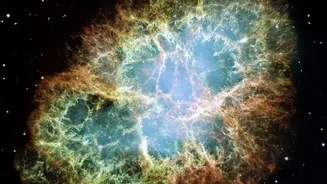
The supernova itself is long gone, but its aftermath persists. What remains is a beautiful, expanding cloud of gas and dust known as Kepler's supernova remnant. This remnant, located about 20,000 light-years from Earth, is now about 14 light-years wide and continues to expand at incredible speeds, with some debris clocked at over 20 million miles per hour. The remnant was first identified with a telescope in 1941. Today, powerful modern observatories like NASA's Chandra X-ray Observatory, the Hubble Space Telescope, and the Spitzer Space Telescope study it across different wavelengths of light, each revealing different features of the superheated material.
Why It Still Matters
Kepler's Supernova is significant for several reasons. It remains the most recent supernova to be unquestionably observed with the naked eye within our own Milky Way galaxy. Studying its remnant provides a crucial link to understanding the physics of Type Ia supernovae. Because Type Ia explosions have a dependably consistent peak brightness, astronomers use them as 'standard candles' to measure vast distances across the universe. These measurements were fundamental to the discovery of dark energy and the accelerating expansion of the universe. By studying Kepler's remnant, scientists can refine their models of these vital cosmic yardsticks.