



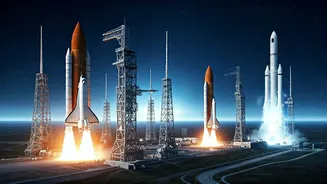


A New Race with New Rules
Unlike the 20th-century duel between the United States and the Soviet Union, which was driven by ideological supremacy, today's competition is a crowded and pragmatic affair. The key drivers are no longer just national prestige, but tangible economic
and strategic goals. Nations and a growing cohort of powerful private companies are vying for control over satellite communications, orbital positions, and the potential for resource extraction. The dramatic reduction in launch costs, pioneered by private firms like SpaceX with its reusable rockets, has democratised access to space, turning low-Earth orbit and beyond into a bustling marketplace of innovation and rivalry. This modern race is less a sprint for a single finish line and more of a marathon to establish a lasting presence and write the rules for humanity's future off-world.
The Two Blocs: Artemis vs. ILRS
The new geopolitical landscape is taking shape around two major competing visions for lunar governance. On one side are the Artemis Accords, a set of principles led by the United States for cooperative and transparent space exploration. As of mid-2025, these accords had been signed by dozens of countries, creating a broad coalition. On the other side is the International Lunar Research Station (ILRS), a joint project spearheaded by China and Russia. The ILRS is envisioned as a long-term lunar base to be constructed in the 2030s and has attracted its own set of international partners. While the 1967 Outer Space Treaty forbids any nation from claiming sovereignty over the Moon, the race is on to establish operational precedent. The first to build infrastructure and set de facto standards for things like resource extraction and navigation could gain a significant long-term strategic advantage, influencing the framework for exploration for decades to come.
The Prize: Why the Lunar South Pole Matters
The focal point of this competition is the Moon's South Pole. The reason is simple: water. In the permanently shadowed craters of this region, scientists have confirmed the existence of water ice. This ice is considered the most valuable resource on the Moon. It can provide drinking water and breathable oxygen for astronauts, but more importantly, it can be broken down into hydrogen and oxygen—the primary components of rocket fuel. Establishing access to this resource could enable the creation of a lunar refueling station, drastically reducing the cost and complexity of future missions to Mars and beyond. Control over these water-rich areas is therefore seen as the key to a sustainable lunar economy and a permanent human foothold in deep space.
India's Power Play: A Pivotal Third Force
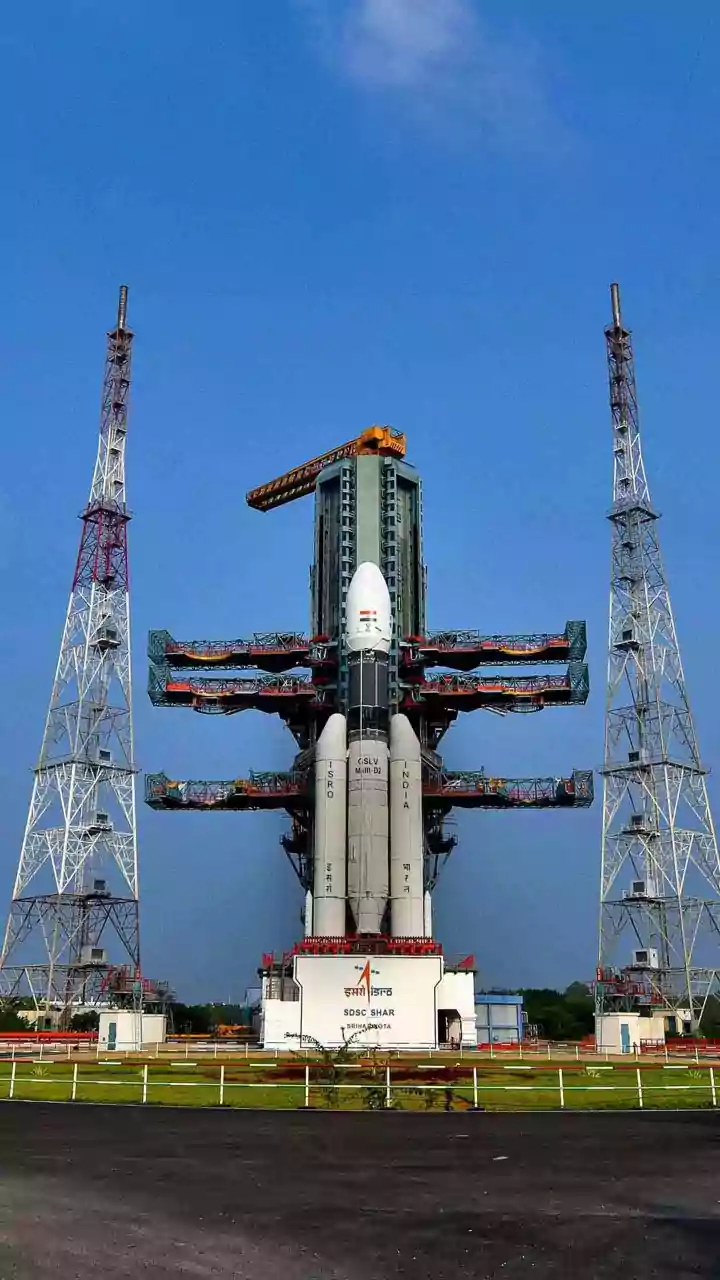
Carving out a distinct and influential position in this race is India. With the historic success of its Chandrayaan-3 mission, which made it the first nation to land a spacecraft near the lunar south pole, ISRO has demonstrated its world-class capabilities at a fraction of the cost of its rivals. India is now a crucial player, pursuing an ambitious roadmap that includes the Gaganyaan program for human spaceflight, a planned lunar sample return mission (Chandrayaan-4), a mission to Venus (Shukrayaan), and the goal of establishing its own space station, the Bharatiya Antariksh Station (BAS), by 2035. While India is a signatory of the Artemis Accords, it maintains its strategic autonomy, collaborating with multiple partners. This positions India not just as a competitor, but as a potential balancing power whose technological prowess and collaborative approach could be pivotal in shaping the future of space governance.
The Commercial Frontier: Musk, Bezos, and the New Barons
Accelerating this entire race are private companies, which have transformed from government contractors into powerful space actors in their own right. Elon Musk's SpaceX now dominates the global launch market and operates the Starlink satellite internet constellation, a critical piece of global infrastructure. Jeff Bezos's Blue Origin is developing its heavy-lift New Glenn rocket and the Blue Moon lander, both integral to NASA's Artemis plans. These companies, and others like them, are not just providing transportation; they are building entire ecosystems for an off-world economy. Their competition for launch contracts, satellite deployments, and lunar landing systems injects a relentless pace of innovation and has become a central theatre of the new space race.