



The Next Giant Leap for India
Chandrayaan-4 represents a monumental step up in complexity for India's space program. A sample return mission is widely considered one of the most challenging feats in space exploration. It involves not just a precision landing, but also launching a spacecraft
from the lunar surface, performing an automated docking in lunar orbit, and safely returning the precious cargo through Earth's atmosphere. Success would make India only the fourth country in the world to accomplish this, after the United States, the former Soviet Union, and China. This mission is not just a scientific endeavor; it is a critical stepping stone, validating key technologies required for India's long-term goal of sending astronauts to the Moon by 2040.
A Complex Dance of Five Modules
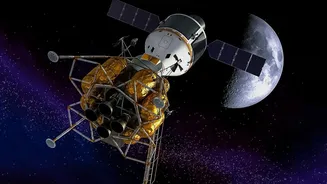
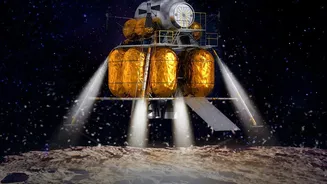
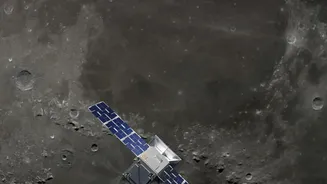
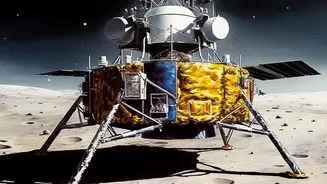
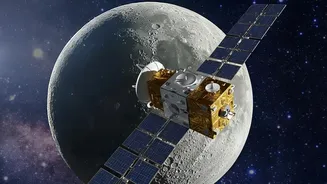
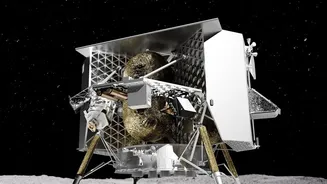
The entire mission is so massive, with a combined weight of around 9,200 kg, that it cannot be launched on a single rocket. Instead, ISRO has engineered an intricate five-module spacecraft. These modules are the Propulsion Module (PM) to travel towards the moon, the Descender Module (DM) for the landing, the Ascender Module (AM) to lift off from the Moon, the Transfer Module (TM) for the journey back, and the Re-entry Module (RM) to bring the samples safely to Earth. This modular design breaks down an incredibly complex task into a sequence of manageable, though still highly challenging, steps.
An Innovative Two-Launch Strategy
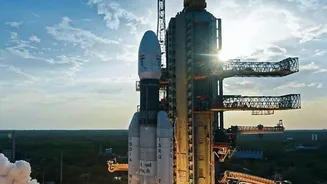
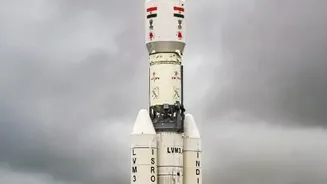
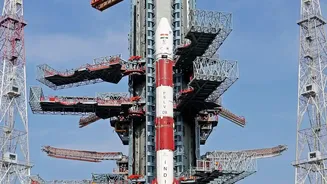
To get all five modules into space, ISRO will employ a novel two-launch strategy using its most powerful rocket, the LVM3. The first launch will carry one stack of modules, and the second launch will carry the rest. These two stacks will then perform a delicate and crucial maneuver: an autonomous rendezvous and docking in Earth's orbit, forming the single, integrated Chandrayaan-4 spacecraft. This orbital assembly, a first for an Indian deep-space mission, is critical. ISRO has already successfully demonstrated this docking capability with its SPADEX mission, paving the way for Chandrayaan-4's success. Once assembled, the craft will begin its journey to the Moon.
The Robotic Hand and Journey Home
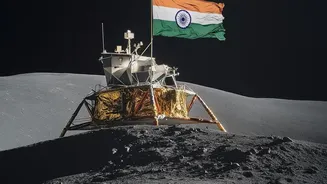
After landing near the Moon's south pole, the Descender will deploy a robotic arm to scoop up surface soil and a drill to collect sub-surface material—amounting to 2-3 kg of lunar regolith. These samples will be sealed in contamination-proof containers and transferred to the Ascender Module. Then comes another critical moment: the Ascender will launch from the Moon's surface, leaving the Descender behind. It will then dock with the Transfer and Re-entry modules waiting in lunar orbit. The samples will be transferred once more, and the Transfer Module will fire its engines to begin the long journey back to Earth, carrying the Re-entry Module and its priceless cargo.
Why Bring Back Moon Rocks?
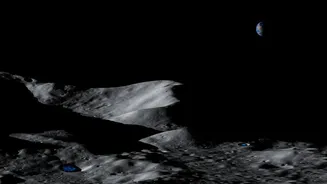
While rovers can perform amazing science on the spot, bringing lunar soil back allows for far more detailed analysis using advanced instruments on Earth. The samples from the Moon's south polar region are of particular interest to scientists globally, as they come from a geologically diverse and largely unexplored area that may contain water ice. Studying these pristine materials will provide invaluable insights into the origin and evolution of the Moon and the inner solar system. It will also help scientists understand the availability of resources for future lunar habitats, moving India closer to its vision of a sustained presence in space.