




The Oxygen Bottleneck
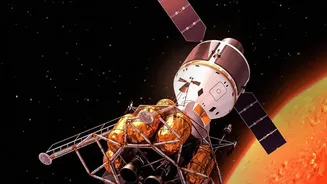
A round trip to Mars is a monumental logistical challenge. While getting there is hard enough, getting astronauts back to Earth requires a powerful rocket launch from the Martian surface. That rocket needs propellant, which consists of fuel and an oxidiser—typically
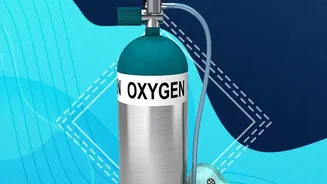
liquid oxygen. The sheer amount of oxygen required, estimated at over 30 metric tons for a Mars Ascent Vehicle, is staggering. Launching that much mass from Earth would be astronomically expensive and complex, requiring multiple heavy-lift rockets just for the return journey's oxygen supply. This 'tyranny of the launch equation' has long been one of the biggest hurdles to planning a crewed Mars mission. Without a way to produce oxygen on-site, the mission's cost and complexity could remain prohibitive.
Living Off the Martian Land
The solution lies in a concept known as In-Situ Resource Utilisation (ISRU), which is a fancy way of saying 'using what's already there'. Mars offers a key resource in its atmosphere, which is composed of about 96% carbon dioxide (CO2). For decades, scientists have theorised that this CO2 could be split into carbon monoxide (CO) and breathable oxygen (O2). The core technology to achieve this is called solid oxide electrolysis. In simple terms, a machine takes in the Martian air, heats it to a very high temperature (around 800°C), and then uses an electrochemical process to strip one oxygen atom from each CO2 molecule. The pure oxygen is then separated and stored, while the carbon monoxide is vented as a waste product. This process would allow future astronauts to create not only breathable air for their habitat but also the vast quantities of liquid oxygen needed for rocket propellant.
From Toaster-Sized Test to Reality
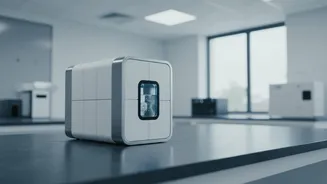
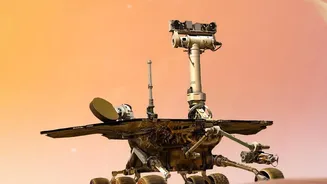
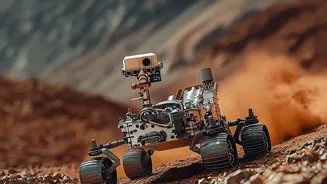
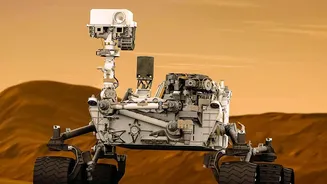
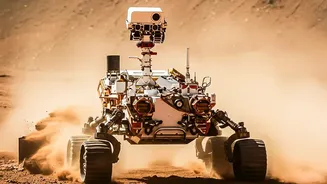
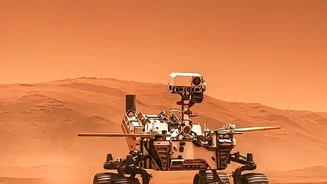
This idea moved from theory to practice with a groundbreaking experiment aboard NASA's Perseverance rover. The Mars Oxygen In-Situ Resource Utilization Experiment, or MOXIE, was a small, toaster-sized device designed to prove the principle on another world. Between 2021 and 2023, MOXIE was run 16 times in the harsh Martian environment, successfully producing high-purity oxygen. At its peak, it generated up to 12 grams of oxygen per hour—roughly double what NASA initially hoped for and equivalent to the output of a small tree. In total, MOXIE produced 122 grams of oxygen, enough to keep a small dog alive for about 10 hours. While a small amount, its success was a monumental proof-of-concept. It confirmed that the technology worked not just in a lab on Earth, but on the dusty, frigid surface of Mars.
Scaling Up for a Human Mission
The success of MOXIE was just the first step. To support a human crew, the technology needs to be scaled up dramatically, from producing grams per hour to kilograms per hour. This is where the latest research comes in. Teams of scientists and engineers are now developing and testing much larger electrolysis reactors. Building on the MOXIE design, these new systems are designed to be far more productive. For instance, development work has produced reactor stacks that are over 30 times more powerful than the components used in MOXIE. The goal is to build an integrated system, essentially a full-scale oxygen plant, that can reliably operate on Mars. A proposed system using half a dozen of these scaled-up stacks could produce oxygen at a rate of around 2 to 3 kilograms per hour, which is the production level needed to fill the tanks of a Mars Ascent Vehicle over the course of about a year and a half.
The Road to a Red Planet Outpost
While scaling up the reactors is a huge leap forward, several challenges remain. A full-size oxygen plant will be a power-hungry beast, requiring a continuous supply of several kilowatts—energy that will likely have to be provided by a dedicated solar farm or a small nuclear reactor sent to Mars ahead of the astronauts. Furthermore, this life-support system must be incredibly durable and reliable, capable of operating autonomously for thousands of hours in the punishing Martian environment with its extreme temperature swings and dust storms. Engineers are now focused on refining these mission-scale systems, ensuring they are not just powerful but also robust enough for the most critical job on Mars: making the air that will sustain human life and provide the ticket home.