


Embrace the Power of Leaves
Who says a pookalam must be all about petals? Nature offers a stunning palette of greens and other hues through leaves. Think beyond just using them for borders. Create the main body of your design with different types of leaves, focusing on their varied
shapes, textures, and shades. Mango leaves, ferns, and other ornamental foliage can be arranged to form beautiful patterns. Use a handful of brightly coloured petals, like marigold or rose, as accents to make the green pop. This approach is not only cost-effective but also gives your pookalam a lush, earthy, and uniquely textured appearance.
Focus on a Central Lamp
Make a traditional nilavilakku (brass lamp) or a cluster of diyas the hero of your design. Instead of creating a large, dense floral carpet, craft a smaller, more intricate circle of flowers directly around the lamp base. When lit, the lamp becomes a radiant centrepiece, drawing the eye and creating a warm, festive glow, especially in the evening. The surrounding flowers act as a beautiful, minimal frame. This design is perfect for smaller spaces like apartment entryways and requires only a fraction of the flowers needed for a full-scale pookalam.
Integrate Rice Flour and Powders
Combine the traditions of pookalam and rangoli for a striking effect. Use white rice flour or powder to draw the intricate outlines of your design. This creates a sharp, clean base that makes even a few flower petals look more vibrant. You can fill some sections of your pattern with rice flour and others with a single layer of petals. For more colour, you can use natural powders like turmeric for yellow and chilli powder for a deep red, though use the latter sparingly. This hybrid technique adds volume and contrast, allowing you to stretch a small quantity of flowers much further.
Master the Minimalist Outline
Sometimes, what you leave out is as important as what you put in. This modern, elegant approach focuses on creating only the outline of a traditional pattern. After sketching your design with chalk, instead of filling it completely, lay a neat, thin line of flower petals along the sketched lines. The empty space within the design creates a delicate, airy look that is both sophisticated and resource-friendly. This works wonderfully with geometric patterns or simple floral motifs. A single colour or two contrasting colours are often all you need to make a powerful statement.
Get Creative with Kitchen Ingredients
Your kitchen pantry can be a treasure trove of colours and textures for a pookalam. Use colourful pulses and grains like yellow moong dal, red lentils, green moong, and white rice to fill in sections of your design. These materials create a mosaic-like effect that is visually stunning and deeply rooted in the harvest theme of Onam. You can use flowers for the central part of the design or as a border, with the grains filling the larger areas. Not only is this an economical choice, but it also adds a wonderfully rustic and symbolic touch to your festive decor.
The Single-Flower Gradient
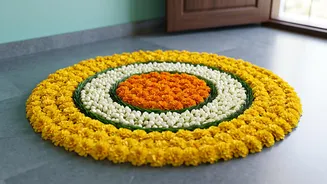
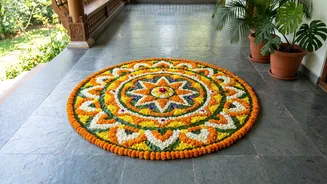
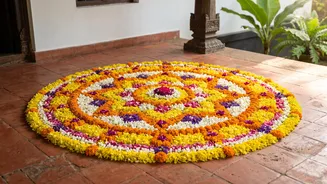
You don't need ten different types of flowers to create a beautiful pookalam. Choose one type of flower that is readily available, such as marigold, and use its different shades to create a simple yet captivating design. Arrange petals in concentric circles, moving from bright yellow on the outside to deep orange in the centre, or vice versa. This creates a beautiful gradient effect. The simplicity of the design, combined with the subtle shift in colour, results in a pookalam that looks harmonious and professionally done without requiring a wide variety of flowers.
Try a Geometric Pattern
Intricate, curving designs often require a lot of petals to look full. Geometric patterns, on the other hand, can look sharp and complete even with minimal materials. Think in terms of triangles, squares, and stars. A simple star shape or a checkerboard pattern can be created with just two contrasting colours of petals. These designs are easy to plan and execute, making them perfect for beginners or those short on time. The clean lines and symmetrical shapes provide a modern twist on the traditional pookalam while being very efficient with your flower supply.