
A Walk Through Time
Sweden is home to a remarkable collection of towns where the medieval footprint is not just visible, but is the very heart of the community. Unlike museum exhibits kept behind glass, these are living spaces where modern life unfolds against a backdrop
of cobbled lanes, half-timbered houses, and centuries-old structures. The defining features of these historical gems are consistently their robust stone churches and the central market squares, or 'Stortorget', that once served as the commercial and social nexus of the entire community. These elements were the twin pillars of medieval urban life: one catering to the soul and the other to the necessities of trade and social gathering.
Sigtuna: Sweden's First Capital
Founded around 980 AD, Sigtuna stands as Sweden's oldest town, nestled on the shores of Lake Mälaren. Its history as the country's first Christian town is etched into its very landscape. During the early Middle Ages, Sigtuna was a bustling religious centre, boasting no fewer than seven stone churches built by wealthy guilds and townspeople. Today, the hauntingly beautiful ruins of three—St. Peter's, St. Lawrence's, and St. Olaf's—remain as powerful testaments to this era. Visitors can wander among these ancient stones, some of which may rest on the foundations of even older church buildings. St. Mary's Church (Mariakyrkan), a 13th-century brick marvel, is the only one to have survived the Reformation intact and still serves as the parish church. The town's main street, Stora Gatan, is believed to follow the same path it did over a thousand years ago, leading through a town plan that feels remarkably unchanged by time.
Visby: The Hanseatic Jewel
On the island of Gotland lies Visby, a UNESCO World Heritage site and arguably the best-preserved medieval commercial town in Scandinavia. Its most striking feature is the formidable 3.4-kilometre ring wall, punctuated by dozens of towers, that still encircles the old town. Visby was a dominant power in the Hanseatic League, and its wealth is reflected in the more than 200 preserved medieval buildings and numerous church ruins. After the Reformation, most of Visby's churches were abandoned, leaving behind a romantic landscape of 'ruins and roses'. The dramatic arches of St. Karin's ruin stand open to the sky on Stora Torget, the main square, where cafe tables now sit where Franciscan friars once walked. This square has been the city's heart for over 800 years, a central stage for commerce and community life. Of the many medieval churches, only St. Mary's Cathedral, consecrated in 1225 for German merchants, remains fully intact and in use today.
Lund and Ystad: Southern Charm
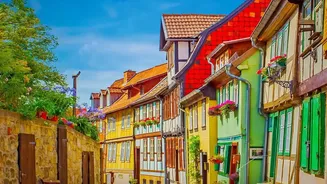
In the southern province of Skåne, the cities of Lund and Ystad offer their own unique medieval character. Founded around 990, Lund once served as the ecclesiastical centre for all of Scandinavia, boasting an astonishing 27 churches in its heyday. Today, the magnificent Lund Cathedral, a masterpiece of Romanesque architecture completed in 1145, dominates the city. While most other churches were demolished following the Reformation, the medieval street plan remains largely intact. Further south, the coastal town of Ystad charms visitors with its pastel-coloured, half-timbered houses and cobblestone streets. Key medieval landmarks include the imposing St. Mary's Church (Mariakyrkan) and the Greyfriars Abbey, one of Sweden's best-preserved monasteries, founded in 1267. Its old town square, Stortorget, continues to be a central hub, surrounded by historic buildings that whisper tales of a rich trading past.