



A Cosmic Game of Hide-and-Seek
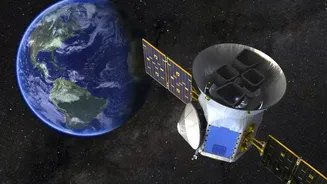
In the vast theatre of space, astronomers often play detective. Using powerful tools like NASA’s Transiting Exoplanet Survey Satellite (TESS), they hunt for distant worlds by watching for tiny, tell-tale dips in a star's light. This dimming, known as a transit,
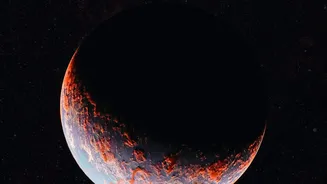
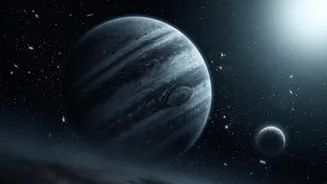
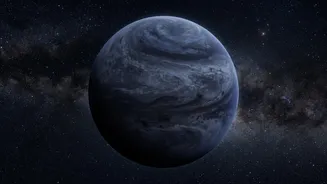
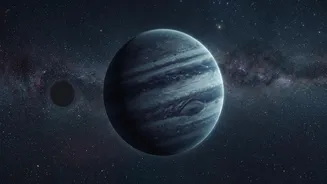
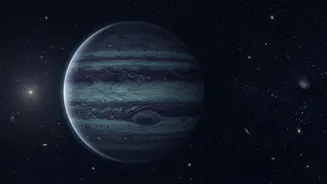
happens when a planet passes in front of its star from our point of view. For seven years, between 2019 and 2026, TESS routinely observed a planet named TOI-2535 b doing just that. This world is a 'hot Jupiter'—a gas giant similar in size to our own Jupiter but orbiting its star in a scorching-fast 8.25 days. But then, something strange happened. The predictable transits grew erratic, sometimes arriving six hours early or late, and became shorter and shallower. And then, in March 2026, they stopped completely. The planet seemingly vanished.
The Unseen Force at Play
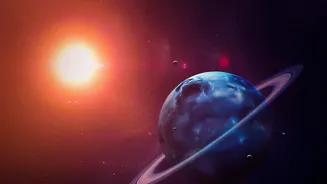
Of course, a planet a thousand light-years away doesn't just evaporate. The solution to the mystery wasn't that the planet was gone, but that our view of it was. Researchers at UCLA and other institutions concluded that TOI-2535 b isn't alone. It's being tugged by the gravity of a massive, unseen neighbouring planet. This gravitational contest is causing the orbits of both planets to wobble like spinning tops. Over time, this wobble tilted TOI-2535 b's orbit just enough that it no longer crosses the face of its star from our perspective on Earth. It's the same principle that makes solar eclipses rare; the Moon's orbit is slightly tilted, so it only perfectly blocks the Sun when everything aligns just right. In this case, the alignment has been broken, and TOI-2535 b is now hiding in plain sight. Scientists expect it will be 30 to 50 years before its orbit wobbles back into view.
The Main Point: Rewriting Planetary Rules
So, why is this 'disappearing act' so important? The main point is that this system directly challenges long-held theories about how planets form and evolve. For decades, the dominant model suggested that planets form in a flat, orderly disk of gas and dust around a young star, much like our own solar system. This 'core accretion' model has trouble explaining hot Jupiters, which are so close to their stars that they shouldn't have been able to form there. The prevailing theory is that they must form much farther out and then migrate inward. However, the neat, slow spiral inward this suggests should result in a 'flat' planetary system where all orbits are on the same plane. The extreme tilt and wobble in the TOI-2535 b system throws a wrench in that idea.
A More Violent Path to Formation
The chaotic dance of TOI-2535 b and its hidden companion suggests a much more dynamic and violent history. Instead of a calm, inward spiral, it’s more likely that these planets were sent on their current paths through powerful gravitational interactions, perhaps a near-collision with another massive object early in the system’s life. This event could have flung the planets into highly tilted and elliptical orbits. What makes TOI-2535 b exceptional is that most known hot Jupiters are lonely, without massive nearby neighbors to disturb their orbits so dramatically. This system, with its two strongly interacting giants, provides a rare, living laboratory for studying planetary migration. It's a snapshot of a formation channel that scientists believe happens, but have never seen with such clarity. The rapid tilting of the orbit, happening on a human timescale, is the most extreme example ever observed.