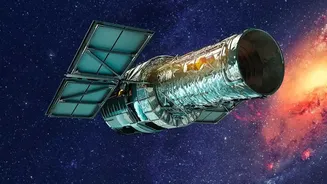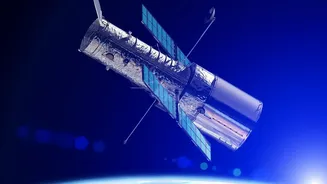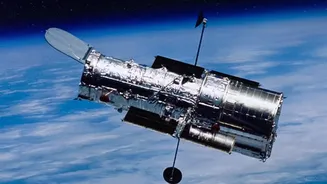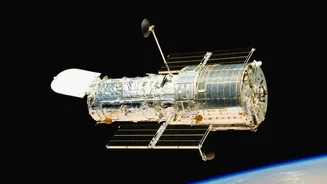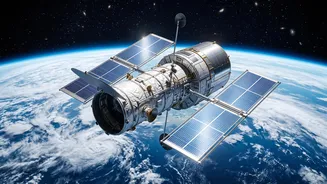



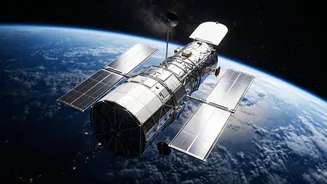
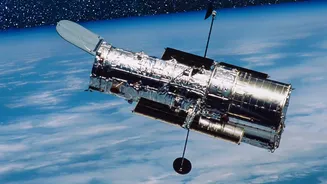

For over 35 years, the Hubble Space Telescope has been humanity's eye on the cosmos, revolutionizing astronomy. But this celebrated icon is slowly falling, and NASA has put out a call for help to save it from a fiery end.
A Slow Fall From Grace
The Hubble Space Telescope doesn't
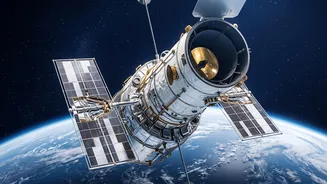
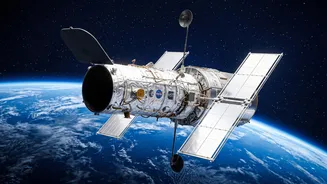
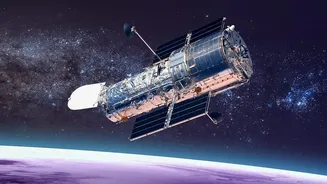
have its own engine to maintain its altitude. Since its launch in 1990, it has relied on periodic servicing missions for a boost. The last time astronauts raised its orbit was in 2002. Since then, the faint but persistent drag from Earth's upper atmosphere has been pulling the school-bus-sized observatory downward. Currently orbiting at an altitude of about 470 kilometres, it is gradually losing height. Projections show that without intervention, Hubble is likely to make an uncontrolled re-entry into Earth's atmosphere sometime between 2033 and 2034. This slow orbital decay is a predictable consequence of physics, but it puts a ticking clock on one of the most productive scientific instruments ever built.
NASA's Call for Bright Ideas
In response to the looming deadline, NASA has formally asked the commercial space industry for help. On October 29, 2026, the agency released a Request for Information (RFI), essentially a market survey to see what's possible. The request outlines three potential paths: boost Hubble into a higher, more stable orbit; service it to enhance its capabilities; or design a mission for a safe, controlled de-orbit. Companies have until November 30, 2026, to submit their ideas. NASA has made it clear that this is an exploratory step and not a formal contract. The agency has not budgeted any funds for a rescue mission but wants to understand the technical approaches, costs, and timelines the private sector can offer. Any potential servicing mission would need to happen by 2032 to be effective.
The Commercial Space Cavalry
This isn't the first time a commercial rescue has been floated. In 2022, a study was conducted with SpaceX to assess the feasibility of using its Dragon spacecraft for a reboost mission, a concept pushed by billionaire and now-NASA Administrator Jared Isaacman. While that specific plan did not move forward at the time, the new RFI opens the door to a wide range of potential partners and technologies, from robotic servicing vehicles to other crewed missions. Companies like Northrop Grumman and Astroscale are also developing satellite-servicing capabilities that could be relevant. The challenge is significant. Any mission would need to safely rendezvous with and capture the delicate, aging telescope without causing damage before performing a complex maneuver.
Why Hubble Is Still Worth Saving
While newer observatories like the James Webb Space Telescope (JWST) have opened new windows into the universe, they are not direct replacements for Hubble. Hubble remains unique in its ability to observe in visible and ultraviolet light, a capability that astronomers want to preserve. Over its three+ decades, it has generated data for more than 23,000 peer reviewed scientific papers, helping to determine the age of the universe, characterize the atmospheres of exoplanets, and capture iconic images that have inspired the public worldwide. Its time is still heavily booked by scientists, and it often works in tandem with JWST to provide a more complete picture of cosmic objects. Extending its life could add another 15 to 20 years of groundbreaking science, ensuring its legacy continues well into the 2030s and beyond.