
The Sun's Unpredictable Power
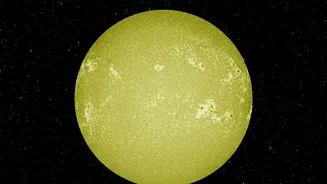
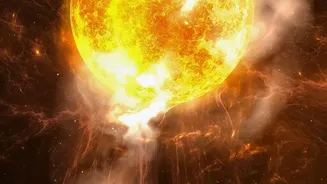
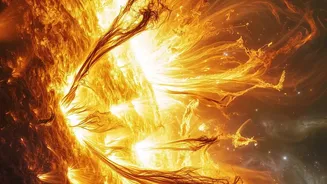
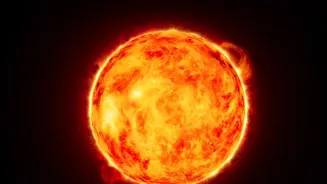
The Sun, our life-giving star, has a volatile side. It periodically releases massive bursts of energy and particles in events known as solar storms. These can manifest as solar flares—intense flashes of radiation traveling at the speed of light—or as coronal
mass ejections (CMEs), which are vast clouds of magnetised plasma and charged particles hurled into space. While the Earth's magnetic field protects us from the worst of this onslaught, a sufficiently powerful and Earth-directed storm can have significant consequences. These are not hypothetical threats. History provides stark warnings. The Carrington Event of 1859, the most powerful geomagnetic storm on record, caused telegraph systems worldwide to fail, shocking operators and even setting paper ablaze from sparks. Auroras, normally confined to polar regions, were seen as far south as the Caribbean. If a storm of that magnitude were to strike today, the impact on our technologically dependent society would be catastrophic.
A Modern World on the Front Line
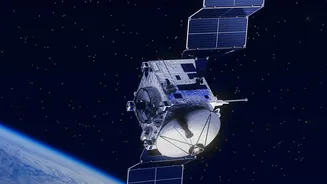
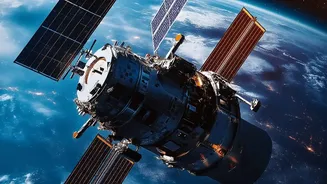
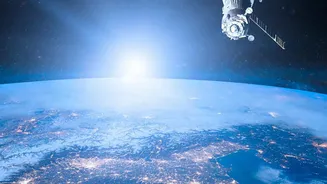
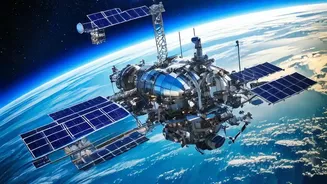
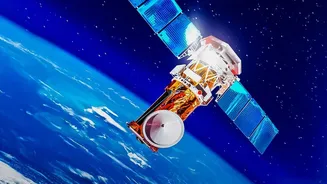
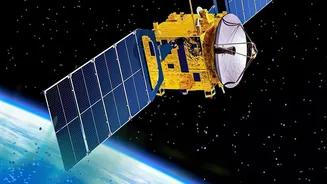
The primary targets of a solar storm are our orbital and terrestrial infrastructure. Satellites are particularly vulnerable. Beyond Earth's protective atmosphere, they can be damaged by high-energy particles that degrade solar panels and fry sensitive electronics. Solar storms also heat and expand the upper atmosphere, increasing drag on low-Earth orbit satellites, which can cause them to lose altitude and even re-enter the atmosphere. This happened in 2022 when a geomagnetic storm caused the loss of 40 newly launched Starlink satellites. On the ground, the danger is just as real. A strong geomagnetic storm can induce powerful electrical currents in long conductors like power lines and pipelines. These currents can overload and damage high-voltage transformers, leading to widespread and long-lasting blackouts. A chilling example occurred in March 1989, when a solar storm collapsed the Hydro-Québec power grid in Canada, plunging six million people into darkness for over nine hours.
Our Global Sky Sentinels
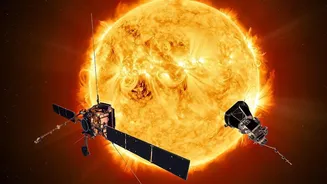
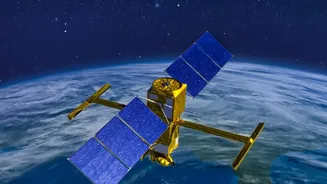
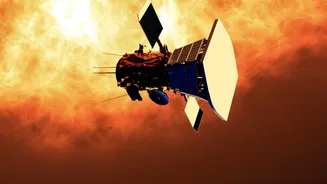
Fortunately, we aren't flying blind. A sophisticated global network of space-based and ground-based observatories constantly monitors the Sun, acting as an early warning system. Agencies like the US National Oceanic and Atmospheric Administration's (NOAA) Space Weather Prediction Center (SWPC) are at the forefront, providing forecasts, watches, and alerts for incoming solar events. These agencies use data from a fleet of satellites like the Solar Dynamics Observatory (SDO) and the Geostationary Operational Environmental Satellite (GOES) series to watch for sunspots, flares, and CMEs. India has also become a key player with its Aditya-L1 mission, the country's first space-based observatory dedicated to studying the Sun. Positioned 1.5 million kilometres from Earth at Lagrange point 1, Aditya-L1 gets a continuous, uninterrupted view of the Sun, helping to track solar activity and improve space weather predictions. These efforts are complemented by ground-based telescopes and radar networks that monitor the Sun and Earth's ionosphere.
From Prediction to Protection
An early warning is critical. Since a CME can take anywhere from hours to several days to reach Earth, a timely forecast gives operators time to act. With a warning in hand, satellite operators can put their spacecraft into a protective 'safe mode', shutting down non-essential systems and orienting them to minimise exposure to harmful radiation. Airlines can reroute flights away from polar regions, where the effects of solar radiation storms are most intense and can disrupt high-frequency radio communication. Power grid operators can also take crucial steps to protect their systems. They can reduce load, postpone maintenance, and prepare to disconnect sensitive equipment to prevent the kind of cascading failure seen in Quebec. While these measures can't stop a storm, they can significantly mitigate its impact, turning a potential disaster into a manageable event.