



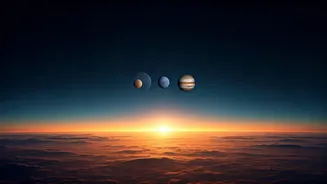


What is a Planetary Alignment?
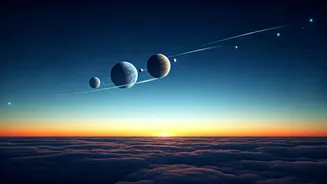
First, let's clear up a common misconception. A planetary alignment, or conjunction, isn't the planets physically lining up in space. Instead, it’s a beautiful illusion from our perspective here on Earth. As the planets orbit the sun at different speeds
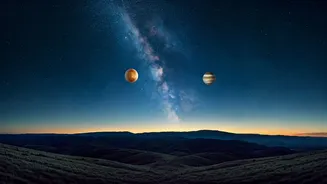
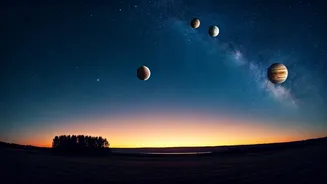
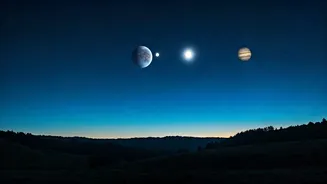
and on different paths, they sometimes appear to cluster together in our night sky. Think of it as watching cars on a multi-lane racetrack; from the stands, they might seem side-by-side for a moment, even if they are in different lanes and at different distances. This particular event brings three naked-eye planets into a tight grouping, creating a rare and striking visual.
Meet the Celestial Trio
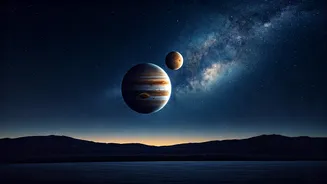
Knowing who you're looking for makes the hunt easier. The headliner is Venus, the brightest object in the sky after the Sun and Moon. Often called the 'Evening Star' or 'Morning Star', its brilliant, steady light is unmistakable. Next is Jupiter, the king of the planets. While not as dazzlingly bright as Venus, it shines with a powerful, unwavering silvery light, easily outshining any actual star. The final member is Mercury. This is the real challenge. As the innermost planet, it never strays far from the Sun in our sky, making it visible only for a short period during twilight. It’s a faint, star-like point of light that’s often lost in the glow of sunset or sunrise.
The 'Low Horizon' Challenge
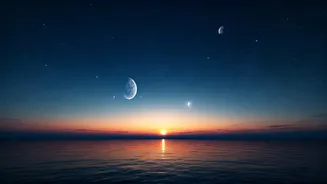
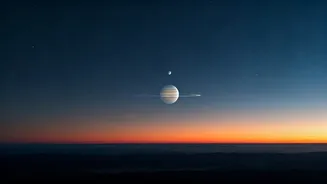
The phrase "low elevation horizon" is the most critical part of this cosmic puzzle. It means the planets will be positioned very close to the horizon, just above the point where the sky meets the land. This presents several challenges. First, they will only be visible for a brief window—typically 30 to 60 minutes after sunset or before sunrise. Any later, and they will have set; any earlier, and the sky will be too bright. Second, their light has to travel through the thickest, haziest part of Earth's atmosphere, which can dim them considerably. Finally, any trees, buildings, or hills on your horizon can easily block the view entirely.
Your Stargazing Game Plan
Success depends on planning. First, you need an unobstructed view of the horizon. For evening alignments, look to the west; for morning ones, look to the east. Rooftops, beaches, or the edge of a large field are ideal locations. Second, timing is everything. Start scanning the sky about 20-30 minutes after the sun has fully set. Venus will likely pop into view first. Use it as your anchor point to find the others. A good stargazing app on your phone can be a game-changer, using your phone’s camera and GPS to show you exactly where to point. Finally, bring patience. Your eyes need about 15-20 minutes to fully adapt to the dark, so avoid looking at your bright phone screen.
Tips for Urban Skywatchers
Trying to spot this from a city like Delhi, Mumbai, or Bengaluru? Don't despair. While light pollution makes things harder, it's not impossible. Your primary goal is to find that clear horizon. Head to a high-rise balcony, a park with a clear western or eastern view, or a quieter peripheral road. The city's glow can actually help by silhouetting the buildings on the horizon, but it will also wash out faint objects like Mercury. This is where a pair of binoculars can be your best friend. They will not only make the planets appear larger but also gather more light, helping to cut through the haze and pull a faint Mercury out from the twilight glow.