


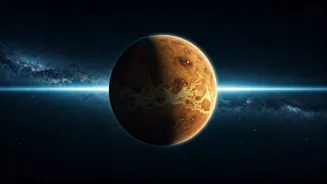


Why Venus is Trending
If you follow any science communicators or astrophotography accounts online, you’ve likely seen it: a post about Venus that seems too weird to be true. These facts about our sister planet's rotation aren’t new, but they are so counterintuitive that they periodically
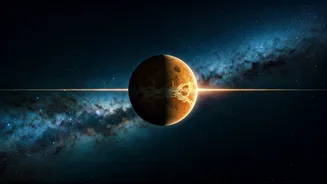
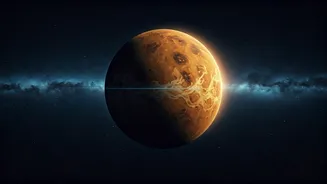
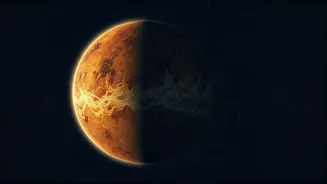
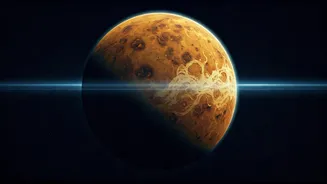
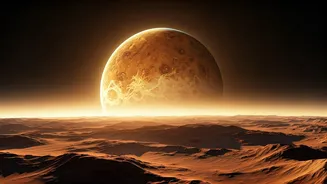
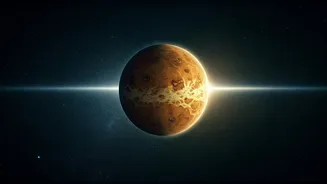
go viral, sparking fresh waves of awe and confusion. Amateur astronomers capturing stunning images of the clouded planet often pair their work with these mind-bending tidbits, reigniting public fascination. The “explosion” isn't about a single event, but a recurring cycle of discovery for new audiences who are rightfully baffled by the alien nature of a planet so close to home.
A Day Longer Than A Year
Let’s start with the headline act. On Venus, a single day is longer than its entire year. It’s a statement that sounds like a riddle, but it’s a matter of simple (yet strange) celestial mechanics. A year is the time it takes a planet to orbit the Sun. For Venus, this journey takes about 225 Earth days. A day is the time it takes a planet to rotate once on its axis. For Venus, this takes an incredibly slow 243 Earth days. This means that if you were standing on Venus, the planet would complete its full orbit around the Sun before it even finished spinning around once. You’d celebrate your New Year’s Day before the sun had even set and risen again.
Spinning the Wrong Way
As if its sluggish spin wasn't odd enough, Venus also rotates backwards. With the exception of Uranus, which is tilted on its side, every other planet in our solar system rotates in the same direction it orbits the Sun (counter-clockwise when viewed from above the Sun's north pole). Venus, however, has a retrograde rotation, meaning it spins clockwise. On Venus, the Sun would rise in the west and set in the east. Scientists aren’t entirely sure why. One leading theory suggests that Venus was struck by a massive asteroid or planetesimal early in its history, which literally knocked it off-kilter and reversed its spin. Another theory posits that the gravitational pull of its incredibly thick atmosphere, over time, slowed its rotation to a stop and then started it spinning in the opposite direction.
The Real Disparity: A Day That Changes Length
This is where the recent buzz gets its fuel. Scientists have long known the approximate length of a Venusian day, but precision measurements were difficult due to the planet’s thick, opaque cloud cover. Recent studies, using radar to pierce through the clouds and track surface features, have delivered a stunning revelation. A 2021 study led by UCLA researchers found that the length of a day on Venus isn't constant. It appears to vary by as much as 20 minutes from one measurement to the next. This “disparity” is likely caused by the planet’s colossal atmosphere. At 90 times the pressure of Earth's, the Venusian atmosphere is so heavy and dense that it literally drags on the planet's surface, exchanging momentum and subtly speeding up or slowing down its rotation. This atmospheric drag, a concept that seems like science fiction, is a powerful force shaping the fundamental rhythm of an entire world.
Why This Bizarre Planet Matters
These aren't just fun facts for trivia night. Understanding the precise rotation of Venus, its core, and the interaction with its atmosphere is crucial for future missions. Knowing exactly how the planet spins is vital for landing a spacecraft safely on its surface. Furthermore, Venus is often called Earth’s “evil twin.” It’s a terrestrial planet of a similar size, but it suffered a runaway greenhouse effect that turned it into a scorching, high-pressure hellscape. By studying why Venus is the way it is—from its bizarre rotation to its toxic atmosphere—scientists can better understand the forces that shape planets, including our own. It provides a stark warning about how planetary climates can evolve and the delicate balance that makes a world like Earth habitable.