


The Limits of the Traditional Lab
For generations, the school science lab has been a place of wonder and occasional dread. It’s where theoretical knowledge meets the real world. However, physical labs come with significant constraints. High-end equipment for experiments in quantum mechanics
or particle physics can cost crores, putting them out of reach for most institutions. Safety is another major concern; experiments involving volatile chemicals, high voltages, or radioactive sources require strict protocols that can stifle curiosity. Furthermore, experiments are often a one-shot deal. If a student makes a mistake, the materials are consumed, the equipment might be damaged, and the opportunity for learning is lost. These limitations of cost, safety, and repeatability have long been a barrier to truly hands-on science education for all.
Virtual Reality's First Step
Virtual Reality (VR) was hailed as a potential solution to these problems. Early VR labs allowed students to put on a headset and interact with a simulated environment. They could mix digital chemicals or wire virtual circuits without any physical risk. This was a significant improvement, offering a level of interactivity that textbooks and videos could not match. However, these first-generation VR labs often felt like playing a video game on rails. The simulations were pre-programmed and lacked true dynamism. You could follow a set procedure, but you couldn't truly experiment. What would happen if you mixed the chemicals in the wrong order or at a different temperature? Often, the simulation would either not allow it or would trigger a simple, pre-canned animation. The underlying physics engine wasn't powerful enough to simulate complex, unexpected outcomes in real time.
The 'Predictive' AI Difference
This is where predictive AI changes the game. Unlike a traditional physics engine that tries to calculate the interactions of every single particle from scratch—a massively demanding task—predictive AI takes a smarter approach. It is trained on vast datasets of real-world physical phenomena or highly accurate simulation data. By analysing this data, the AI learns the fundamental rules and patterns of physics. Instead of calculating, it learns to *predict* what will happen next based on the current state of the system. This allows for incredibly complex and realistic simulations—like fluid dynamics, chaotic systems, or multi-body gravitational interactions—to run smoothly and instantly inside a VR environment. The AI isn't just running a script; it's applying its learned understanding of physics to whatever the user does, creating a truly dynamic and responsive world.
A Safer, Smarter Way to Learn
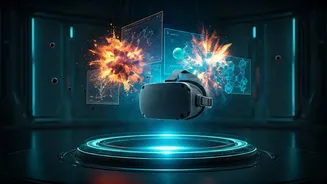
The combination of this predictive power with the immersive nature of VR creates a learning tool of unprecedented potential. A student can simulate a volatile chemical reaction and see exactly what happens when the mixture becomes unstable, with a detailed, scientifically accurate explosion contained safely within the headset. They can design a faulty bridge and watch it collapse, with the AI showing them the precise stress points and engineering failures in real time. They can run an experiment a hundred times, tweaking one variable each time to build an intuitive understanding of cause and effect. This environment encourages failure as a learning tool, not a costly mistake. It transforms the lab from a place of rigid procedure to a sandbox for genuine scientific inquiry, fostering deeper and more intuitive understanding of complex principles.
Democratising Science Education in India
The implications for a country like India are immense. We have a vast pool of bright, ambitious students but a wide disparity in the resources available to educational institutions. While top-tier IITs and research institutes may have state-of-the-art labs, many colleges and schools across the country simply cannot afford them. AI-powered VR labs can level the playing field. For a fraction of the cost of a single piece of high-end equipment, an institution could provide its students with a virtual lab containing hundreds of simulated experiments. It's a scalable, affordable solution that can bring world-class practical science education to every corner of the country, preparing a new generation of scientists, engineers, and innovators for the challenges of tomorrow.